Chapter 63, including 1939 Directory
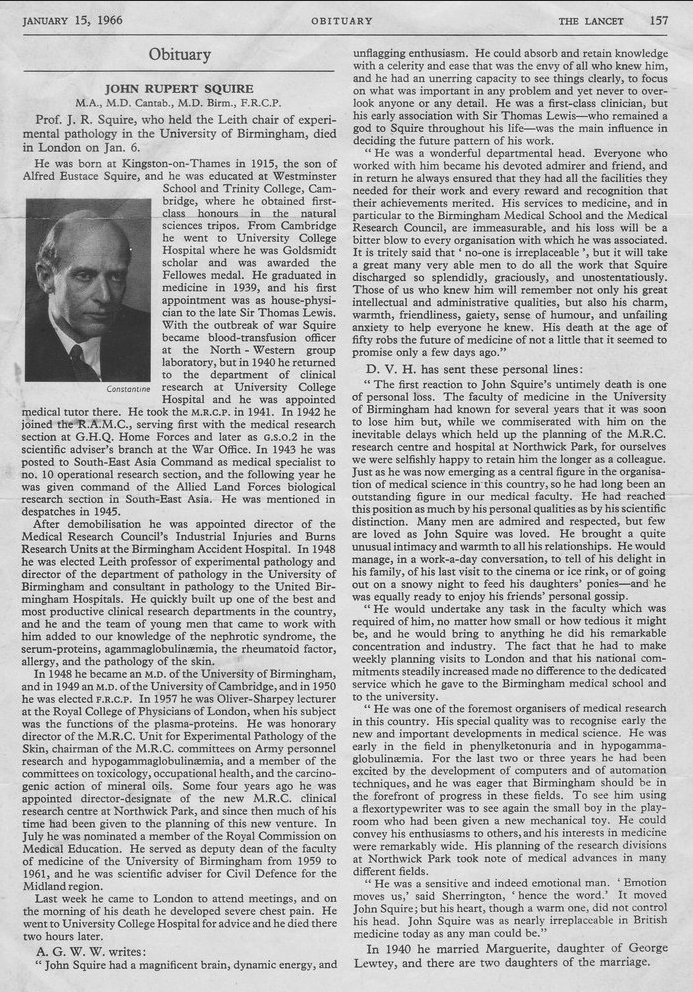
On 6 Jan 1966, my Grandad, John Squire, died suddenly. It was my Gran’s birthday. And Epiphany – a wise man was missing at my cradle 6 months later. Here is his obituary from the British Medical Journal – the photo is from the Journal of Pathology. (See also posts #029, #042 and #052)
The Lancet also covered John’s illustrious medical career at some length but, on a more personal note, contributions to the obituary noted that he “had a magnificent brain, dynamic energy, and unflagging enthusiasm. He could absorb and retain knowledge with a celerity and ease that was the envy of all who knew him, and he had an unerring capacity to see things clearly, to focus on what was important in any problem and yet never to overlook anyone or any detail.” He recognised new and important developments early, and was excited by developments in computing and automation. “…few are as loved as John Squire was loved… he was a sensitive and indeed emotional man.” He would “tell of his delight in his family… or of going out on a snowy night to feed his daughters’ ponies.” Both commentators described him as nearly irreplaceable as any man might be.
The John Squire Library still exists at Northwick Park.

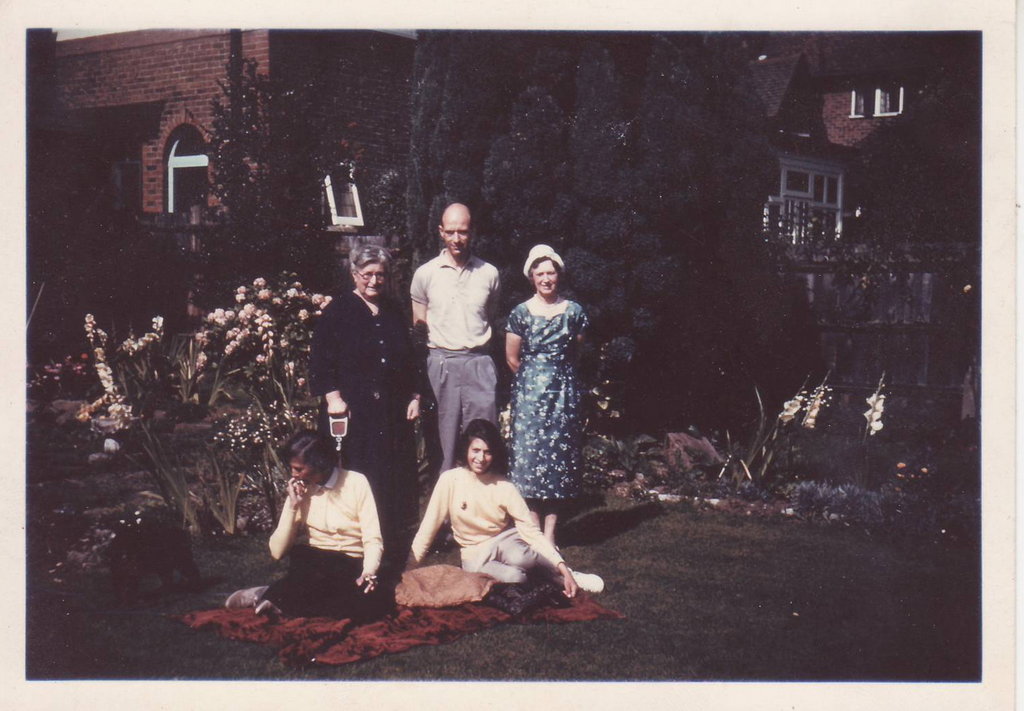
It was quite a coincidence that he was posted to British India in WWII. He met my Gran (who liked us to call her by her first name, Marguerite) at Cambridge. She would have been caught up in the war out East herself had she not sailed to Britain in 1935 to continue her studies. It’s another matter of regret that I never had the chance to talk economics with Marguerite, given that she managed a 1st Class Degree at Rangoon, despite having completed the first two years in one. She ‘blazed a path’ to England in 1935, where she was permitted to shorten her Degree at Newnham College, Cambridge, too.

John and Marguerite married in 1940, and John joined the army in 1942. These were strange times – another relative recounted to me how he and his mother escaped India to Australia. There he joined the Australian Air Force, only to be posted back to his mother’s home town, and then to Swindon!
John’s obituary recounts that he had command of the Allied Land Forces biological research section in South-East Asia, and that he was mentioned in despatches but I don’t know why, nor have I heard that he ever talked about it.
1939 WIP
Squire, Alfred Eustace (5 Mar 1885). Director of private company [Reeve Angel]; paper maker’s agent. d 1944
Squire, Elsie M (20 Feb 1888)
Squire, John Rupert (20 Aug 1915). Not present. Graduated from University College Hospital in 1939. m Marguerite, Hampstead, Apr 1940.
Lewtey, Marguerite M (later Squire)(6 Jan 1914). Economics graduate from Rangoon and Cambridge.
[Fowler-]Gregory, Lilian D [Jane Gregory](7 Nov 1900). Domestic, ladies’ housemaid. d Lambeth, 1970
Rozel, Claremont Lane, Esher, Surrey
According to his obituary in ‘The Lancet’: With the outbreak of war Squire became blood-transfusion officer at the North-Western group laboratory, but in 1940 he returned to the department of clinical research at University College Hospital and he was appointed medical tutor there. He took the MRCP [examination for Membership of the Royal Colleges of Physicians] in 1941. In 1942 he joined the RAMC [Royal Army Medical Corps], serving first with the medical research section at GHQ Home Forces [which commanded all formations and units in the UK except those of AA Command and training establishments] and later as a GSO2 [General Staff Officer, ranked a Major] in the scientific adviser’s branch at the War Office [which was later responsible for the research behind nuclear civil defence]. In 1943 he was posted to South-East Asia Command [which included India and Burma] as medical specialist to no. 10 operational research section, and the following year he was given command of the Allied Land Forces biological research section in South-East Asia [there are records showing that the section surveyed the troops on their attitudes, revealing resentment at wasting time (especially after the end of the war), and anger at red tape and ‘bullshit’; it may also have been concerned with combating venereal disease.][Later these sections were closely associated with research into the effects of exposure to nuclear radiation]. He was mentioned in despatches [for gallant and distinguished services in Burma (London Gazette 17 Sep 1946. Lt-Col (temp), 236276)].


After demobilisation he was appointed director of the Medical Research Council’s Industrial Injuries and Burns Research Units at the Birmingham Accident Hospital. In 1948 he was elected Leith professor of experimental pathology and director of the department of pathology in the University of Birmingham and consultant in pathology to the United Birmingham Hospitals. He quickly built up one of the best and most productive clinical research departments in the country, and he and the tam of young men who came to work with him added to our knowledge of the nephrotic syndrome, the serum-proteins, agammaglobulinaemia, the rheumatoid factor, allergy, and the pathology of the skin.
In 1948 he became an MD of the University of Birmingham, and in 1949 an MD of the University of Cambridge, and in 1950 he was elected FRCP. In 1957 he was Oliver-Sharpey lecturer at the Royal College of Physicians in London, when his subject was the functions of the plasma-proteins. He was honorary director of the MRC Unit for Experimental Pathology of the skin, chairman of the MRC committees on Army personnel research and hypogammaglobulinaemia, and a member of the committees on toxicology, occupational health, and the carcinogenic action of mineral oils. Some four years ago he was appointed director-designate of the new MRC clinical research centre at Northwick Park, and since then much of his time has been given to the planning of this new venture. In July he was nominated a member of the Royal Commission on Medical Education. He served as deputy dean of the faculty of medicine of the University of Birmingham from 1959 to 1961, and he was scientific adviser for Civil Defence for the Midland Region.
Two contributions to the obituary noted that he “had a magnificent brain, dynamic energy, and unflagging enthusiasm. He could absorb and retain knowledge with a celerity and ease that was the envy of all who knew him, and he had an unerring capacity to see things clearly, to focus on what was important in any problem and yet never to overlook anyone or any detail.” He recognised new and important developments early, and was excited by developments in computing and automation. “…few are as loved as John Squire was loved… he was a sensitive and indeed emotional man.” He would “tell of his delight in his family… or of going out on a snowy night to feed his daughters’ ponies.” Both commentators described him as nearly irreplaceable as any man might be.
The John Squire Library still exists at Northwick.
Squire, Harriet née Green (1854). Widow (of John Traviss) d 1941
Not found. d Kingston upon Thames