Facebook post #015 (May 2020 – 014 was a progress update, hoping everyone was coping with Covid 19)
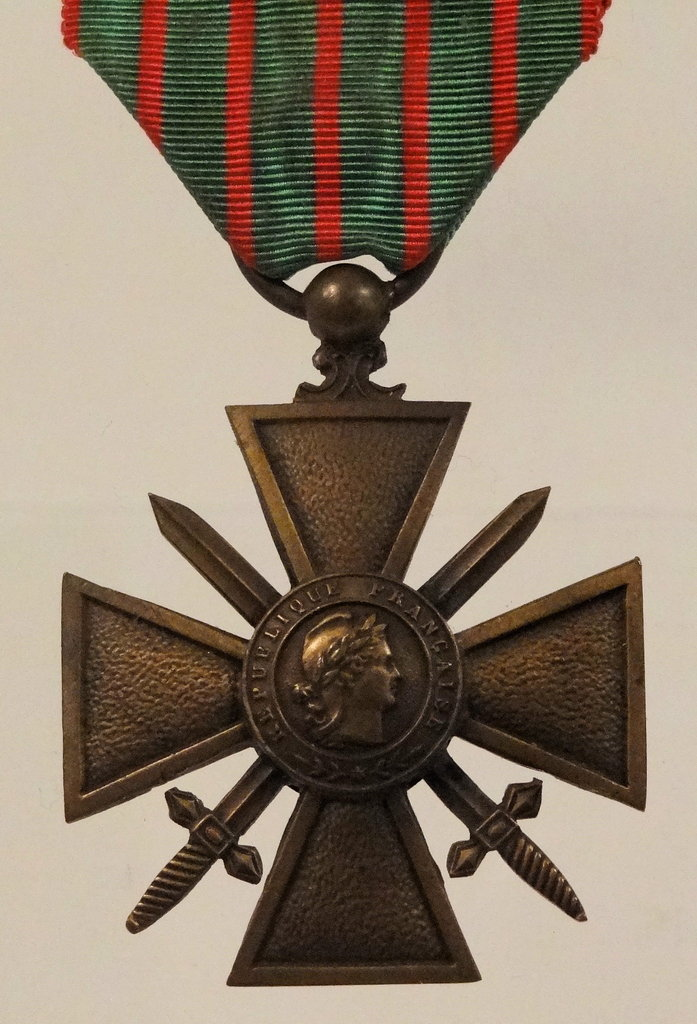
I’ve been checking my family tree work. Managed to miss one chap‘s kids. One of his sons owned 25 Thames sailing barges. One of his grandsons was awarded the Air Force Cross, and died on the R-38. Another was consulting surgeon to the British Second Army, was awarded a Croix de Guerre, and made a Companion of the Order of the Bath, and a Knight of Grace of the Order of St John. Good job I checked…
Update (Nov 2022): Well it gave me the chance to finish the blog project, I suppose. Apparently, the expression derives from the Dutch verlof, “leave of absence”.
Facebook post #013 (11 May 2020)
I just found out that one of my relatives, Bert Baker, was furloughed. This was 100 years ago, mind, and it took ten days to get back from Alexandria before his leave could begin. He was in the Machine Gun Corps (the regiment with no history to fall back on, and a 36% casualty rate).
The form completed by his commanding officer has faded badly but I can make out “Sobriety: drinker. Is he reliable? Fairly. Is he intelligent? Average.”
When he wasn’t called back after six months, he married a German girl in Crouch End.
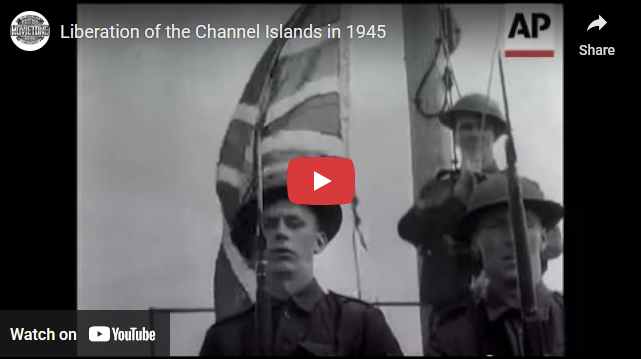
While VE Day was being celebrated 75 years ago yesterday, the swastika was still flying over the government buildings in Jersey. My relatives still had to carry German ID cards. This on British soil – closer than York to where I live now. There were severe punishments for those caught with illicit radio sets, or milling illicit flour to feed the islanders. Forced labour had been used to build a giant underground hospital, now believed to be a gas chamber intended for the undesirables of the British mainland. Happily, that flag was lowered 75 years ago TODAY, and the Channel Islands were liberated from the jack boot.
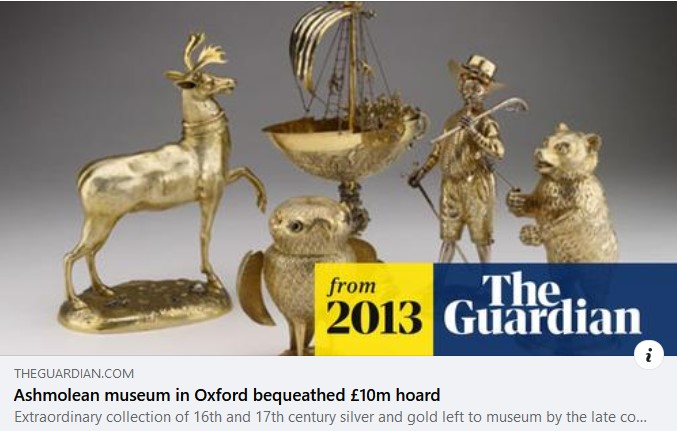
So, in 1875 my first cousin died in the notorious rookeries around Seven Dials in London, a site of unspeakable squalor, open sewers and all. A three minute walk and twenty years away, my second cousin’s family moved into new business premises in Covent Garden. The business prospered. When their grandson died in 2012, part of his silver and gold collection was sold for £3m at Sotheby’s, and he left about £10m-worth to the Ashmolean.
My cousin in the rookeries was Emma (who married her first cousin). The rich family was Edward and Alice. The basis of the story was Dad’s Dad Grandad marrying another of Emma’s first cousins (they lived in Shropshire), and Dad’s Mum’s cousin marrying the jeweller (they lived in Kent).
But look! Those neighbouring families – of dramatically different fortune – inter-married, via the son of colour box Jabez, resulting in a indirect linking of the Barnards and Littles a generation before my grandparents joined the families.
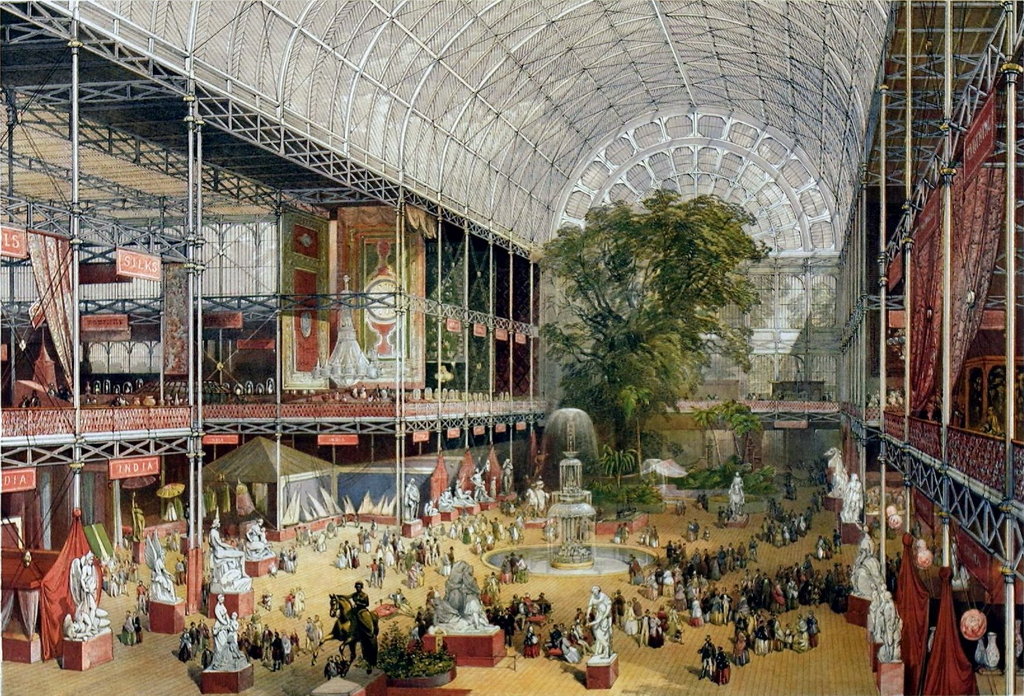
#OnThisDay in 1851, the Great Exhibition opened in Hyde Park. It was visited by over six million people – equivalent to a third of the entire population of Britain at the time. The profits were then used to found the V&A, Science Museum and the Natural History Museum… Family history follows…
Facebook post #009 (Apr 2020 – 006-008 were progress updates)
OK, so we’ve reached the great war in the family history… the Great Chocolate War. With the younger sons in Mum’s family trying to make a living away from the family farm in Yorkshire at this time, and Dad’s moving out of Peaky Blinder country, it’s not too surprising that some of the cousins ended up working in chocolate factories. (See George Powell and Leonard Lambert). This was the start of cocoa for the masses. Who would win, Rowntree, or Cadbury?
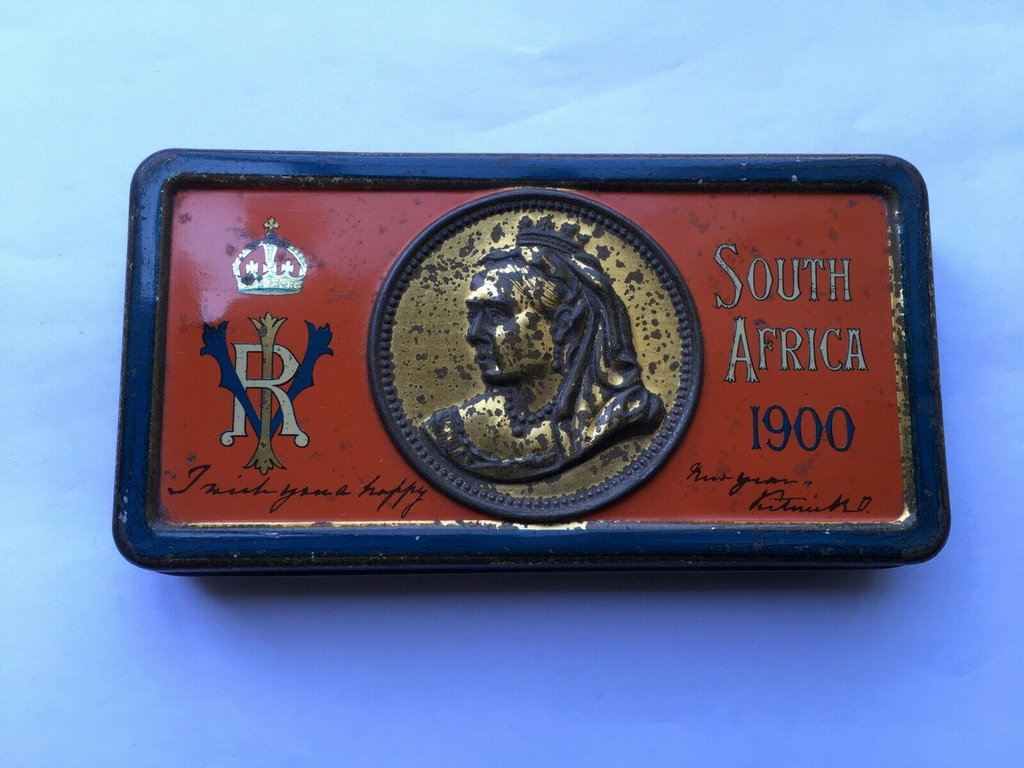
Victoria Chocolate Tin
The picture is of a tin in my collection, the result of a collaboration between the Quaker chocolate company founders, reluctant to support the actual war effort, but also reluctant to offend the Queen. It was a luxury Christmas present for troops in the Boer War.
By WWII, chocolate was considered an essential household food.
So, combining photos from a bunch of places we visited last year, I’m working my through from Edwardian to modern to upload to Flickr in order.
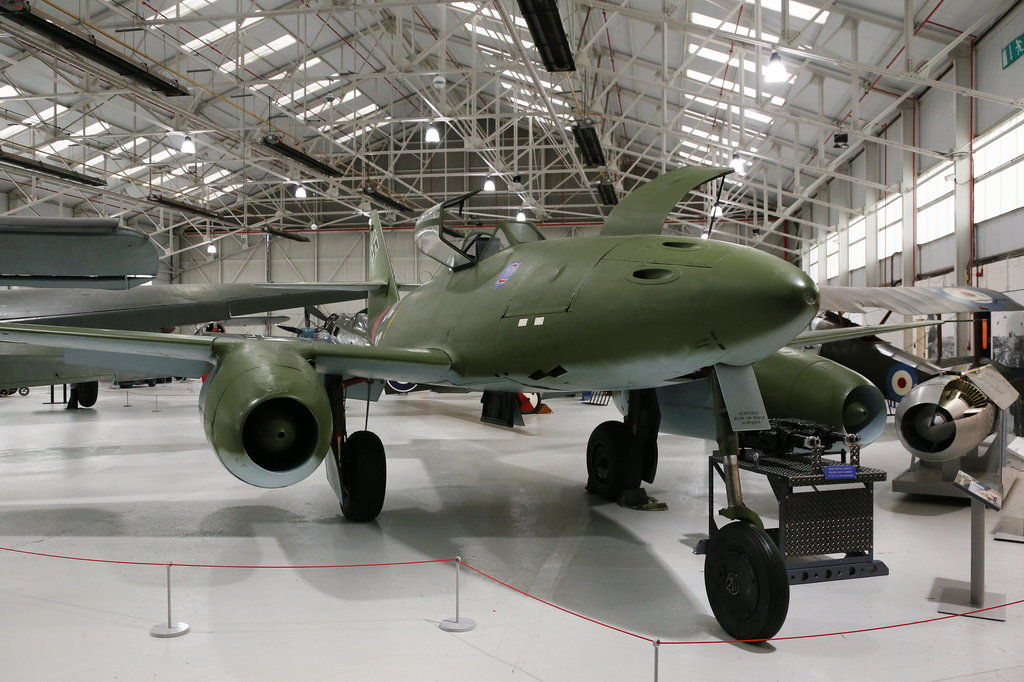
I’m up to this sleek machine – which was as much a leap forward as the Spitfire had been over the Gladiator.
Messerschmitt Me 262 (1944-5)
Five or so survive around the world; a swarm of 30 was one of the last things my grandmother’s second cousin, Bruce Maclennan RCAF, saw of this earth. With sickening invevitability, a burst of 30mm shells took the nose off his unescorted Avro Lancaster, over a U-Boat yard, near Hamburg. Such was 1945.
Last week we were in 1871, and left John Traviss Squire boarding in Sheffield, a 15-year-old solicitor’s articled clerk. At the time, his 16-year-old future wife Harriet Green was at home with her iron founder father William (post 53) five miles north on Ecclesfield Common.
John and Harriet married in 1880 and shortly afterwards moved to Birdhurst Road, Wandsworth, where they still lived in 1891. From here, John would have commuted by rail to Waterloo (the line was extended in 1854), walked over the old Waterloo Bridge, and turned right along the Thames. This was the amazing new Victoria Embankment, which provided modern sewerage, so John would have been spared the Great Stink (see post 44), and his way would have been lit by Britain’s first electric street lighting.
Seats on Westminster Embankment (my photo)
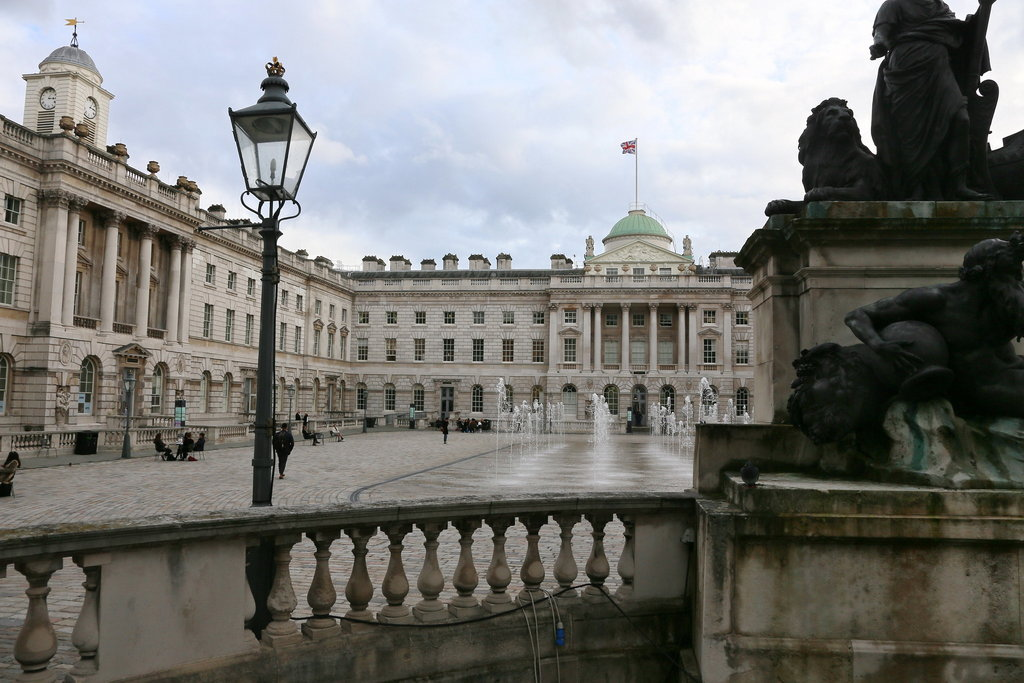
He worked as an Assistant Solicitor for the Inland Revenue – Income tax had been introduced in 1842. I imagine the sight of Somerset house would have impressed our John from Barnsley every day, as it did me when I finally visited last year.
Somerset House, London
Somerset House also held all England’s birth, marriage and death records since the start of registration in 1837. I was surprised to discover that John had taken a pioneering interest in these records, and had undertaken a local study of Wandsworth, and particularly of Huguenots (for reason unknown). His work is still being used as a source: I even found it cited in Wikipedia.
John liked a pint – actually a quart! I cleaned up his old tankard a few years ago, gradually making out the words chiselled on the base. The first word around the base was “Duke”, which looked promising… Then, eventually, I worked out that it said ‘Duke of York, Cheapside, Barnsley’! There are pictures online of this pub being knocked down… Across the middle, it says ‘Cricketers, Kingston’. More luck this time: I was able to take a pint here from John’s tankard a few years ago.
The Cricketers, KingstonThe Cricketers, Kingston (interior)John’s tankard
John also played the violin – Uncle Eddie Squire once sent me a picture. Some of his books survive, including a music book (pic) and some learned tomes, such as a Pope with the plea to ‘Return Duly with the corners of the leaves NOT TURNED DOWN’, a doodled Byron, a Voltaire in French, and sundry battered Latin tomes.
John’s Book
John died in 1894, aged 39. Update: Christopher Squire has shared the rumour that he was found dead in a railway carriage on return from a work assignment in York. A sad pre-echo of my grandad’s end… or could there have been foul play? But we have an update!
For several years he had held an appointment at Somerset House. Last week he was on business in Bolton and Wakefield, and being unwell, came to Barnsley. Typhoid developed, and he was removed to the hospital, where he died.
Leeds Mercury 15 Nov 1894
As is often the way, less is known of Gt-Gt Gran Harriet. It can’t have been easy as a young widow. In 1901 and 1911, she was in Kingston upon Thames with her surviving children. Kingston is named after the King’s Stone, the coronation stone of King Æthelstan (post 54) and others.
Coronation Stone, Kingston
Given his tankard’s inscription, perhaps John moved there late in his short life. My Grandad John, the couple’s grandson John (post 51) was born there.
Market House, Kingston
Harriet died in 1941, nearly 50 years after John’s passing, having lived through WWI, and the WWII blitz when 447 bombs dropped on Kingston. Extended widowhood was sadly normal for the Squires: both his grandfathers were outlived by decades by their widows, as were his son, Alfred E Squire and grandson, John Squire.
On 4 July 1917, a 21-year old Royal Navy air mechanic was one of three killed in a bombing raid on Felixstowe. This I learned today in researching family history: James Cordell was my grandad’s third cousin, and hailed from Southampton. As I’ve been looking at old planes with my son lately, I dug a bit deeper.
So, by 1917, planes like the Royal Aircraft Factory BE2 below (which we saw at RAF Hendon) had become increasingly successful in bringing down the Zeppelin airships which had terrorised London early in the War.
Royal Aircraft Factory B.E.2B (1914-19) Replica (my photo)
But The resulting hiatus was suddenly ended by a series of raids by the giant Gotha biplane bombers of the new ‘England Geschwader’. The first two raids were aborted, their bombs being dropped on the south coast. The fourth was redirected due to weather conditions, and killed cousin James.
James looked after kite balloons which were beginning to have some success as observation platforms from which to spot ‘U-boats’. Flying boats based nearby were developing new techniques to destroy the submarines. Seaplanes developed in Felixstowe provided early funding for the companies which made them, and which came together after the War to form English Electric – of Lightning and Canberra fame.
In 1968, EE became a founding component of GEC, where both my parents worked. I moved to Wellingborough to work for GEC Reliance, and this is why my children were born in Northants. The Felixstowe site was used after the War by Supermarine, who developed the Southampton flying boat below, to replace the older models. Later, of course, they created the Spitfire.
Supermarine Southampton (1925-36) (my photo)
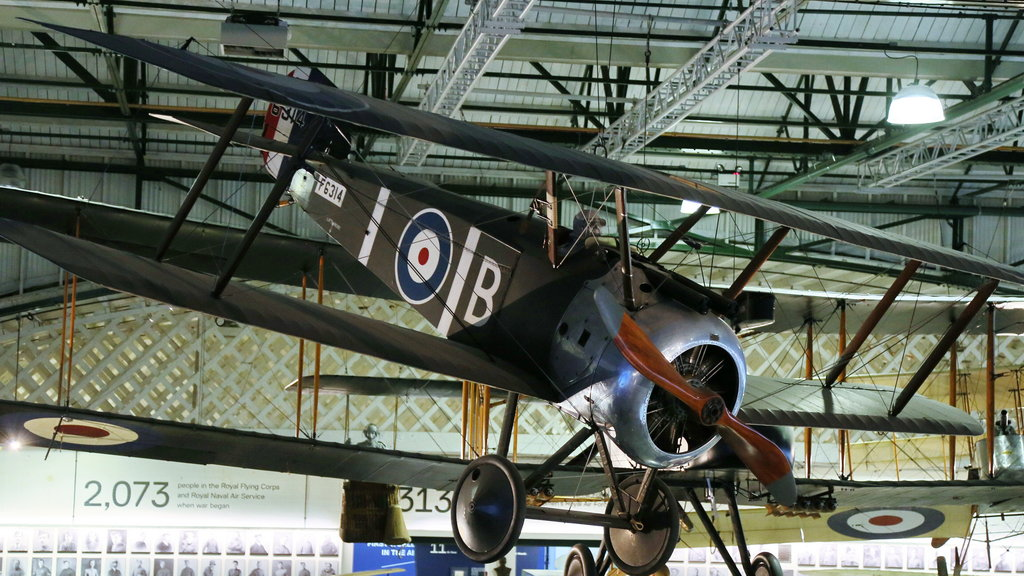
Back in 1917, the third raid, on 13 June, was on London. 17 planes dropped 4 tonnes of high explosives. 162 people were killed, including 18 children in a primary school in Poplar. As a result of these raids, Jan Smuts was commissioned to review the air services. His report led directly to the foundation of the RAF, which started in 1918 as the Independent Air Force. It consisted of nine squadrons of planes including the De Havilland DH9A and Sopwith Camel, below, which now have pride of place at RAF Hendon.
The revulsion to all things German after the raids led directly to the royal family rebranding itself from Saxe-Coburg-Gotha to Windsor on 17 July 1917.
Airco De Havilland DH9 (my photo)Sopwith Camel (my photo)
Doing a bit of family tree. I have Fred Parrott, son of Fred Parrott, and Ernie Parrott, son of Ernie Parrott. Different parents, same grandparents. Then we have brother Major Parrott who married a Frankie. The there is Frank Parrott, son of Frank Parrott, son of Frank Parrott, and a Frank Parrott son of George Parrott, and a Dick Parrott, son of Harry Parrott and all three have different parents but the same grandparents – but (obviously)(partially) different from Fred and Ernie’s. It turns out that the middle Frank, has a brother-in-law called Frank Collier. He also has a nephew called James Parrott, and a brother called James Parrott, and a brother-in-law called James Collier. This James Collier is the son of James Collier who married first Ann Astbury, and then Alice Mary Astbury. James Collier Jr married a different Alice Mary. Their son Sid only had three grandparents as James and Alice were half first cousins. One of these was my 4th great aunt, Martha Barnes, since you ask. And they were all farmers in C19 Staffordshire.
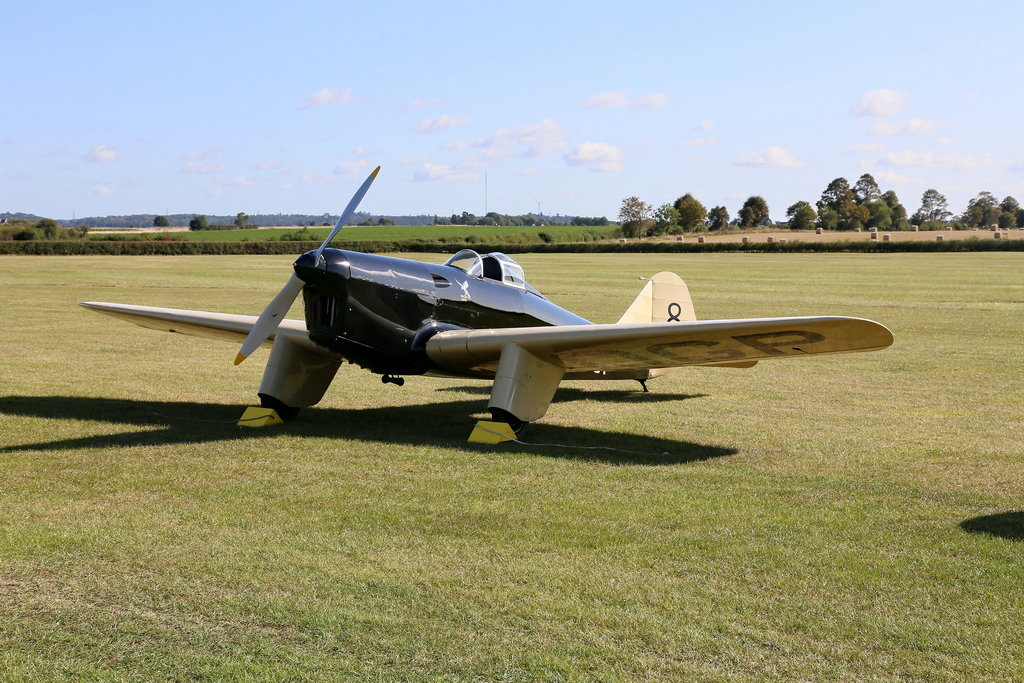
Update (Jan 2020): Even better – one of the Parrots could fly. Third cousin x2 James Edward Parrott got his Royal Aero cert in 1948 in a Miles Hawk at Wolverhampton Aero Club. Here’s one I snapped last summer (a Hawk, not a Parrott).