The daughter of the niece from Jersey is Mum’s 2nd cousin Antoinette Hérivel, and she is a painter in Gabriola Island, British Columbia (which, incidentally but interestingly, she acknowledges as being on the unceded territory of the Snunéymuxw First Nation).
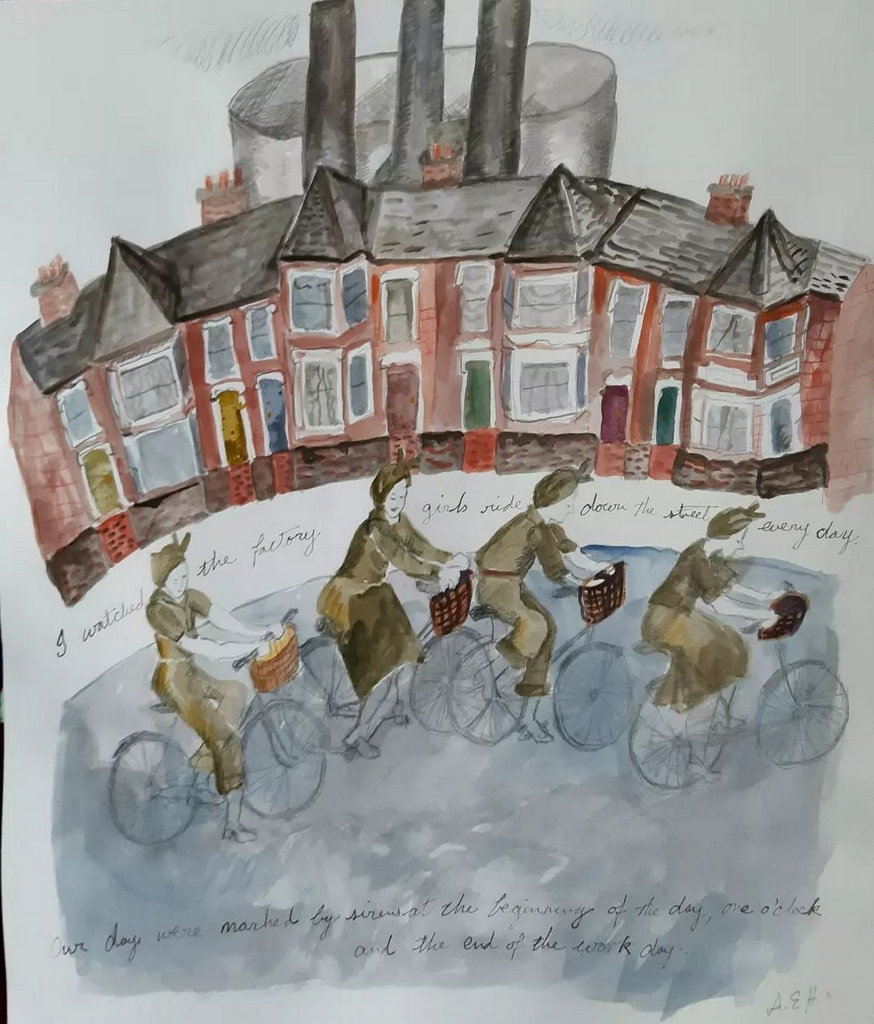
Antoniette’s work is often autobiographical, and I did know that she had spent time in Swindon when I found them in the census. However, it was still surprising to see that her Facebook banner is a picture of Swindon in the 1950s, complete with reference to the works hooter!
Painting of Swindon by Antoinette Herivel
She has had many exhibitions over the decades but her first publically displayed painting was in Swindon Town Hall.
More of Antoinette’s work can be seen on Instagram.
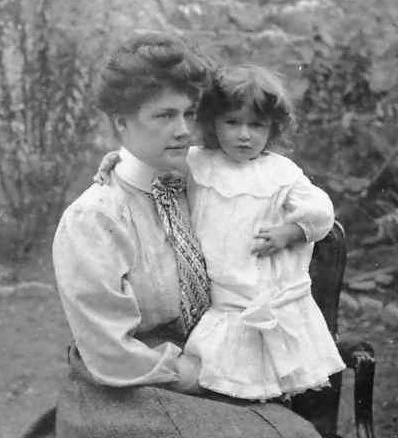
Found posted online a new pic, allegedly of my gt-gt gran (see posts #059 and #060). I originally posted that I would love to verify (I had doubts) but that the family resemblance is there.
Marilyn Beale has helped crystallise the thought. Looking at other photos, I think it is more likely to be my gt-gran’s sister Isabel Jane in about 1915. She had married a businessman of Scottish descent, and had a son and daughter in Jersey before they emigrated to Australia in 1913. The daughter Dorothy (presumably pictured) married in Tasmania. The son was lost at sea there while shark fishing in 1945.
Isabel (Le Brun) Mills
Incidentally, the exact dates for the family have been hard to pin down as they were methodists, and the records are yet to be fully digitised. Isabel’s niece, Estelle, married a Wesleyan minister, settling for a while in County Road, Swindon in the 1950s.
My gt-gt-grandfather, Moses Le Brun, is 21 and working for the family business. His sister Lydia is 11, and a scholar. There was no college for girls, but Lydia would be lucky – the family would fund her to complete her education at the Sorbonne in Paris. This was partly achieved by her elder sisters taking in ironing. The Sorbonne looks like it may have been quite austere at the time, but Lydia apparently took an interest in the Parisian impressionist painting of the time.
Sisley – Après la débâcle, la Seine au pont de Suresnes (1880)
By the next census, in 1881, Lydia was back at home, and a schoolmistress.
Elsie and he Le Brun Family, 1908
Ten years on, the family were at Zelzah House (still standing), where Lydia had founded her own school. Apparently, “she was very strict and not above using corporal punishment, but was interested in bringing the latest methods of education, including exercising with dumbbells.” Several of the family attended the school, including her niece, daughter of Esther (posts 59 and 60) and my gt-gran Elsie.
Elsie was also lucky in being allowed to complete her education – it was more easily afforded by this time. Antoinette recalls that she was “very gifted and went to London University, at the time of the suffragettes. Elsie was my great aunt and recounted that she studied English with one of the WWI poets.” So, UCL was the first British university to admit women on fully equal terms to men (except in Medicine) but it was still relatively unusual for women to be admitted before WWI.
After I’d been digging around for the blog, I happened upon a philosophy textbook of Elsie’s dated October 1908, which confirms that she was there. The best known war poet from UCL was Isaac Rosenberg, who studied at The Slade School of Fine Art, which was known for its acceptance of female students (and for its Francophilia). I found a contemporary picture showing plenty of respectable young ladies! I reckon that it the School probably offered some interdisciplinary study then – as it does now. Including English and Philosophy alongside Fine Arts seems reasonable.
The School also has a history of producing suffragettes, including Mary Lowndes, Ernestine Mills and Georgina Brackenbury. Olive Hockin was there at the same time as Elsie.
Pan! Pan! O Pan!Bring Back thy Reign Again Upon the Earth, 1914 by Olive Leared
The Women’s Social and Political Union (WSPU) was founded in 1903, the year in which Elsie turned 18. Two years later, they convinced the Liberal MP Bamford Slack to introduce a women’s suffrage bill: the publicity spurred rapid expansion of the group. In June 1908, the WSPU deployed its new purple, white, and green campaigning colours at its 300,000-strong “Women’s Sunday” rally in Hyde Park. Perhaps Elsie was there. Certainly, there were strong women in the family – including her mother with whom she is pictured below in the same year. Certainly the women were cross that they couldn’t be properly educated in Jersey.
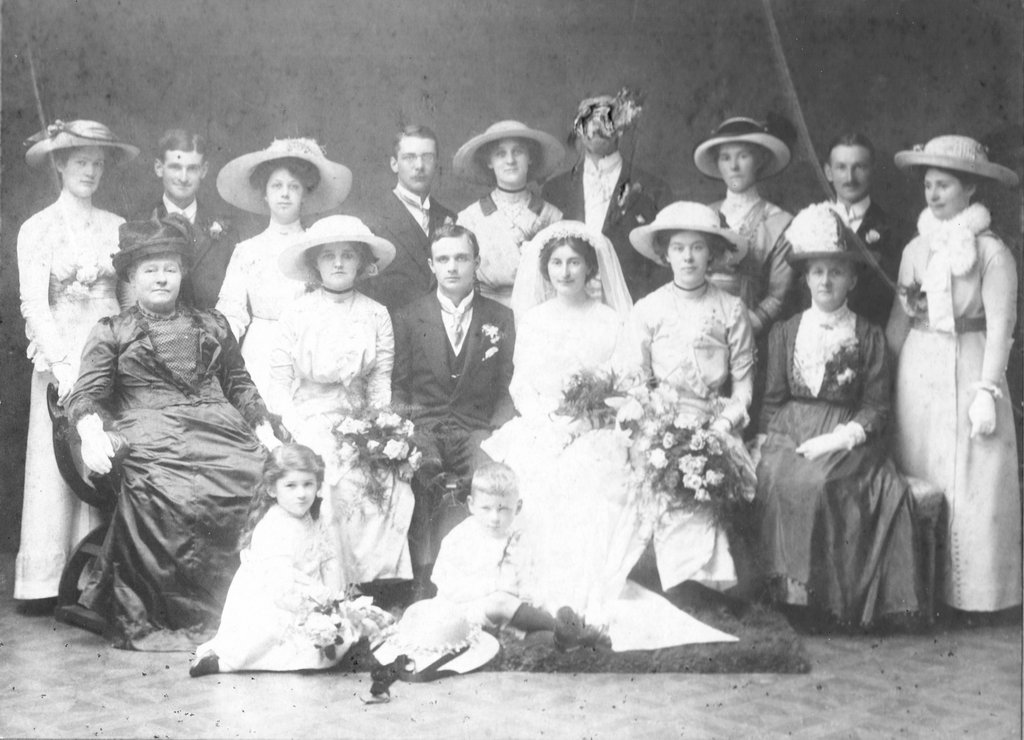
Amongst whatever other excitement Elsie may have experienced in London, she somehow met my gt-grandad, Alfred. I don’t think he went to university (he was a clerk in 1901, and a manager in 1911). They married in St Helier on 12 June 1913 (pic).
Alfred and Elsie Squire’s Wedding
Isaac Rosenberg was killed on night patrol in France in Spring 1918. Shortly before, he penned:
Through these pale cold days What dark faces burn Out of three thousand years, And their wild eyes yearn, While underneath their brows Like waifs their spirits grope For the pools of Hebron again—For Lebanon’s summer slope. They leave these blond still days In dust behind their tread They see with living eyes How long they have been dead.
Alfred and Elsie settled in Esher, Surrey and named the family home after Rozel in Jersey.
Rozel, Esher
They got to experience the trip of a lifetime together on the RMS Queen Mary (post #058). Alfred died during WWII, but Elsie lived until 1970, and I have a faint memory of meeting her.
Mum tells me that she played at Clare Hill Golf Club at the end of the road. On at least one occasion, she won, and brought home an engraved plate as a trophy. She had a housekeeper for company, whose brother sometimes drove Elsie around in her big, old Wolseley (of the type pictured). She sometimes drove herself, too, and she still had the car when she died, when it would have been thirty years old. So that’s where I get it from…
Nicolas and Guillaume de Grouchy ride off on the First Crusade. They will be present at the fall of Jerusalem. By tradition, their descendants held fief at Rozel, Jersey. We know for sure that Guillaume de Gruchy (b. 1284) came to the island after the French conquest of Normandy.
Our Le Brun family wasted money claiming ancestral lands in Brittany, and it turns out that our de Gruchy family from Normandy were no less litigious. And very handy too have the court records been for the Channel Islands Family History Society. The de Gruchy family was based at La Chasse, a courthouse/farmhouse in the Trinity parish from 1362 to 1847. The house still exists – close to Gerald Durrell’s zoo – but it was remodelled when it was sold.
La Chasse, Trinity, Jersey
However, our branch only inherited the property through ten generations. Wives came from the Larbalastier, Poingdestre, Nicole, Hamptonne, and Hubert families. It was Noé (d. 1668), a (litigious) bone-setter who was the first not to live at La Chasse but he, and the next four generations, stayed close by in the parish of Trinity. Wives were from the Grossier, Le Quesne, Fiffard, Esnouf and Remon families.
Finally Helier, in 1777, was born outside Trinity! He married Anne Mauger, and their son Philippe (1804) was the first to appear in the census. By 1851, he and his wife Marie Coutanche, were a mariner and dressmaker respectively. Their elder son, Jean Philippe (1837) was apprenticed to a shipwright from age 13. He married Esther Deslandes in 1858, by which time he was a ship’s carpenter. Their first born was my gt-gt-grandmother, Esther Elisabeth, who would grow into the formidable baker we met in post #059.
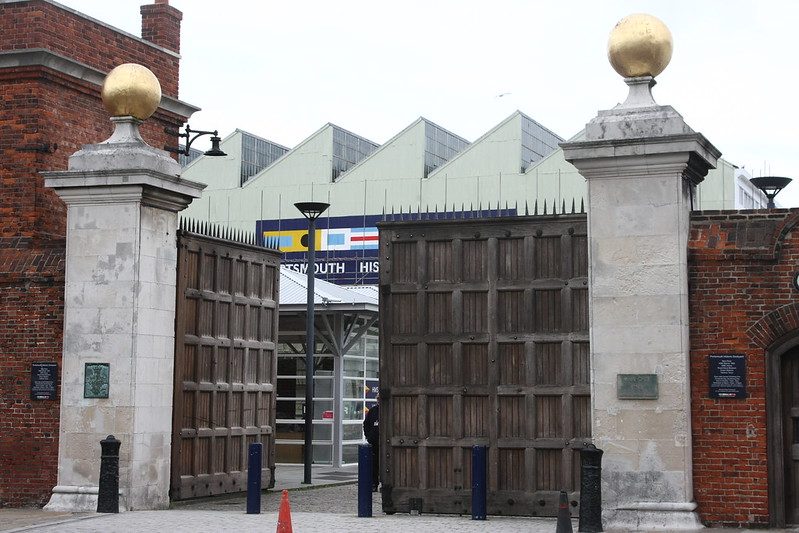
Then the family abruptly dropped out of Jersey history… Esther Elisabeth’s marriage having been on Portsea Island provided the clue. It turns out that Jean Philippe – now “John P De Gruchy” – had moved to Portsmouth to work in the Royal Naval Dockyard, the biggest industrial site in the world at the time. The youngest child, Ada, was born half a mile from Dicken’s birthplace (my photo), half a year from his death (see post #021).
Dickens Birthplace, Portsmouth
Legend has it that the docks were founded by Richard the Lionheart of Crusades fame. Certainly, the first warship was built in the world’s first dry dock there in 1497, followed by the Mary Rose in 1511. Nelson’s HMS Victory (my photo) was still in active service at Portsmouth in 1831. In 1843, work began on reclamation of land to allow a huge expansion to allow steam ships to be built. By 1860, wooden warships were deemed too vulnerable to and HMS Warrior, Britain’s first iron-hulled battleship was built as the pride of Queen Victoria’s fleet.
Dock, PortsmouthHMS Victory
John went over to work in a new complex of interconnected basins (my photo), each of 14–22 acres (5-9 hectare), built for the huge new ships. Each basin served a different purpose: ships would proceed from the repairing basin, to the rigging basin, to the fitting-out basin, and exit from there into a new tidal basin, ready to take on fuel alongside the sizeable coaling wharf there. Many of the associated buildings, which would have been familiar to John are preserved as part of the Historic Dockyard (my photos).
Examples of ships built while John was there show how much things moved on in the late C19. HMS Calliope (1884)(pic) exemplified the late Victorian navy – she was built on the same pattern as earlier wooden ships but had a steel frame; as well as full sail rig, she had a powerful engine. HMS Devastation (1896) was low in the water with masts only for signalling purposes. Her guns were mounted in turrets, and she was armoured with iron plates 12 inches thick.
HMS CalliopeHMS Devastation
Jean and Esther had retired back to St Helier, close to the bakery, by 1901, so he just missed working on the revolutionary battleship HMS Dreadnought, with her main battery of 12 inch guns. However, many of the ships he would have worked on saw service in WWI. Warship production continued in Portsmouth until the launch of HMS Andromeda in 1967 – she was decommissioned in 2012. I last visited in 2019, to see the new aircraft carrier HMS Queen Elizabeth leaving her new home harbour for the first time (my photo).