The first Standard-built Triumph, with razor-edge coachwork by Mulliners of Birmingham, on tubular chassis. 2000 had Vanguard-style chassis. 1.5-litre. A few LWB limousines were made, with sliding division.
Years
1946-48 / 1949 ; 1949-52/1952-54
Engine
1776cc / 2088cc S4
Body Style
Production
4000 / 2000; 6501 / 2800 + 190 limo
Power: Weight
.
Dimensions
.
Exhaust on nearside for 1800.
Triumph 1800 / 2000 Roadster
Roadster version. 1800 engine was similar to that provided to Jaguar for their 1.5-litre. Old-school styling, complete with dickey seat
Years
1946-48 / 1949
Engine
1776cc / 2088cc S4
Body Style
Production
2501/ 2000
Power: Weight
.
Dimensions
.
.
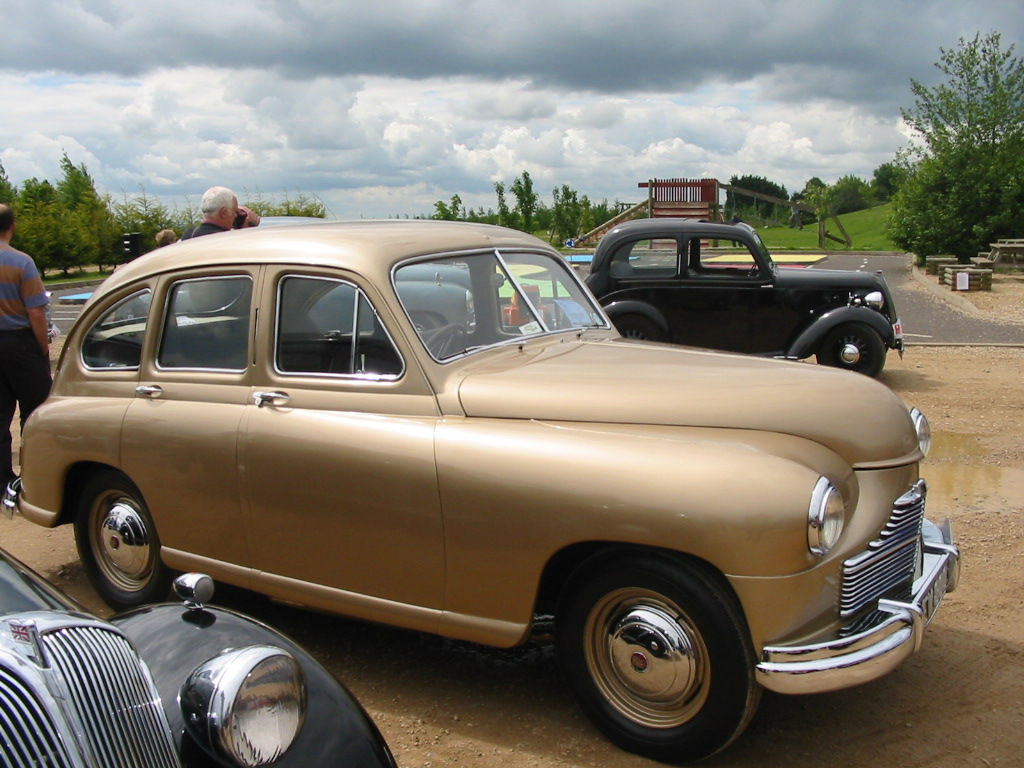
Standard Vanguard Phase I
“Tough six-seater hack” with Plymouth-style looks (Walter Belgrove sketched US embassy cars). Wet-liners, hydraulic brakes, coil IFS. Export only, and successful in Australia, Germany etc; eventually assembled in multiple countries.
Years
1948-52
Engine
2088cc S4
Body Style
Sal, est (50-), DH (Bel), ute (Aus), van
Production
184,799
Power: Weight
.
Dimensions
.
Rear-wheel spats from 1950, lower bonnet line & new grille from 1952
Triumph Mayflower
If the Vanguard was selling US styling to the empire, the Mayflower attempted to sell Britishness to America. The company’s first unitary car had proven mechanicals, dodgy handling, and unusual styling – and ended the experiment.
Years
1950-53
Engine
1247cc S4
Body Style
Saloon, a few DHC
Production
35,000
Power: Weight
.
Dimensions
.
.
Triumph TR-X
Belgrove’s futuristic roadster was another experiment for the Triumph brand, complete with aerodynamic, light alloy body, and pop-up headlights. It was Vanguard underneath, with twin-carb version of its engine.
Unofficial moniker for the facelifted car with the 100 bhp engine (later also enlarged). Another export-focused car, successful in the USA.
Years
1957-61
Engine
1991/2138cc S4
Body Style
Production
58,236
Power: Weight
.
Dimensions
.
.
Triumph Vignale Vanguard
Michelotti’s first modest contribution to the compnay was this face-lifted Vanguard.
Years
1958-61
Engine
2088cc S4
Body Style
Production
26,276
Power: Weight
.
Dimensions
.
.
Standard Atlas
The company’s entry into the light van market against competition from Bedford, BMC, Ford and Rootes. Available with 10 or 12 cwt capacity, and as a van (with hinged or sliding doors), or a flatbed.
Standard set up in a small building in Much Park Street, Coventry, and experimented with small numbers of every size of car. None survive. The company also made engines for other manufacturers.
Years
1903-05
Engine
S1, 2, 3, 4, 6 1009/1609/1766cc etc
Body Style
Production
Power: Weight
.
Dimensions
.
Standard 20HP, 30HP, 40HP, 70HP
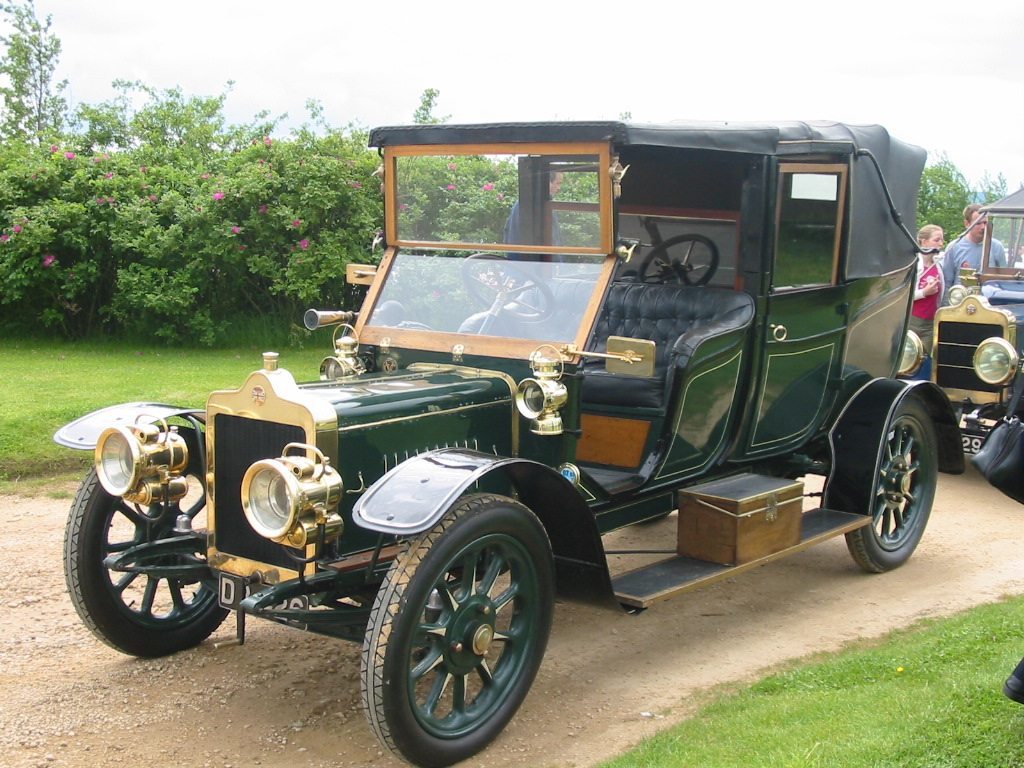
In 1906, the company moved to larger premises in Cash’s Lane, and initially focused on 6-cylinder models. The oldest surviving car is the Roi de Belges 30HP in Coventry Transport Museum.
Years
1906-14
Engine
S6 5300/6200/11700cc
Body Style
Production
Power: Weight
.
Dimensions
.
Model shown is a 30HP cabriolet.
Standard 8, 11, 12, 15, 16HP
By 1911, Standard was again offering a full range of cars. The 8 was apparently good value, and popular.
Standard joined the vogue for volume-produced ‘light’ cars typified by the Morris and Singer 10 HP cars. So, an updated 4-cylinder model was introduced in 1912, with the company focusing on large-car reliability.
Years
1913-15; c. 1918 (“S”)
Engine
S4 1087cc
Body Style
Various 2-seater tourers
Production
1933; 198
Power: Weight
.
Dimensions
.
Model shown is Rhyl Tourer (1914)
Standard SLS 9.5 / 11 HP
An update on the Model S, arguably a stop-gap model (V1-V3) to take advantage of resurgent demand after WWI. The first Standard 8, low-slung with disc wheels was, tried in 1921, but under-developed, perhaps a victim of SLO success.
Longer wheelbase to create 4-seaters for a core market; OHV engines. By 1924, market share was comparable to Austin, at more than 10,000 cars. Cars still named after British towns. Tourers were actually genuinely weatherproof.
Years
1921-28; 1927-30
Engine
S4 1009/1609/1766cc OHV(14)
Body Style
Saloons; tourers
Production
c. 30,000 (15k 14 HP)
Power: Weight
.
Dimensions
.
Model shown is 11/14 SLO4 Warwick Saloon (1923). Saloons were new!
Standard 18/36; 18/42
The first post-WWI six-cylinder offering using overhead valves like the S4 14, and with a lengthened frame, and servo brakes. Not ideal timing for the launch, and they were sold off in bulk after a reputation for poor relability set in.
Years
1926-29
Engine
S6 2230cc
Body Style
Saloons; tourers
Production
.
Power: Weight
.
Dimensions
.
.
Standard Nine / Big Nine
Quickly designed as a modernisation of the mass-produced 4-cylinder model, although Standard returned to sleeve valves. ‘Worm’ drive apparently inspired by French Mathis designs. Proven by endless drives around the Cotswolds!
Years
1928-31
Engine
S4 1287cc
Body Style
Saloons; Selby tourer.
Production
c. 10,000
Power: Weight
.
Dimensions
.
Model shown is (steel-bodied) Teignmouth. No grille shoulders from 1930.
Standard 15 / 16 / 20
More effective replacement for the 18/36 than the 18/42, and – like the 4-cylinder models, marked a return to sleeve valves. Twenty (from ’31) was longer, and available as a 7-seater or a landaulet, echoeing the Edwardian cars.
Years
1928-35
Engine
S6 1930cc (15); 2054cc (16); 2552/2663cc (20)
Body Style
Saloons; tourers
Production
.
Power: Weight
.
Dimensions
.
Model shown is a 16 from 1935
Standard Little Nine / Little 12 / Big 12
New baby of the range, augmented by a six-cylinder Little 12, and lengthened Big 12 only for 1933.
Years
1932-33
Engine
S4 1005cc (9); S6 1337cc (12); 1497cc (B12)
Body Style
Saloons and tourers.
Production
.
Power: Weight
.
Dimensions
.
Standard Nine / Ten / 12 / 16
A new range for ’34 with new frames and new engines. The ten had different. slightly streamlined styling, and was available as a sports saloon and coupe. The 12 was now 4-cylinder but still on a longer wheelbase.
Another new range, this time with more streamlined bodies and backward-leaning grilles. The 12 was the first-launched of the new 4-cylinder models, using the same engine as the outgoing model. 14 from ’37.
Years
1936-40 (14 from 1937); 1945-48
Engine
S4 1608/1776cc
Body Style
1937 Light 12 Tourer shown. Waterfall grille from ’38
Production
9959/22,229 post-war
Power: Weight
.
Dimensions
.
Standard Flying 16, 20, V-Eight
The six-cylinder Flying Standards came in various wheelbases, and also reused the engines of the outgoing models. The V-VIII was an exciting answer to Ford (two 10HP blocks and common crankcase) – too exciting on this chassis…
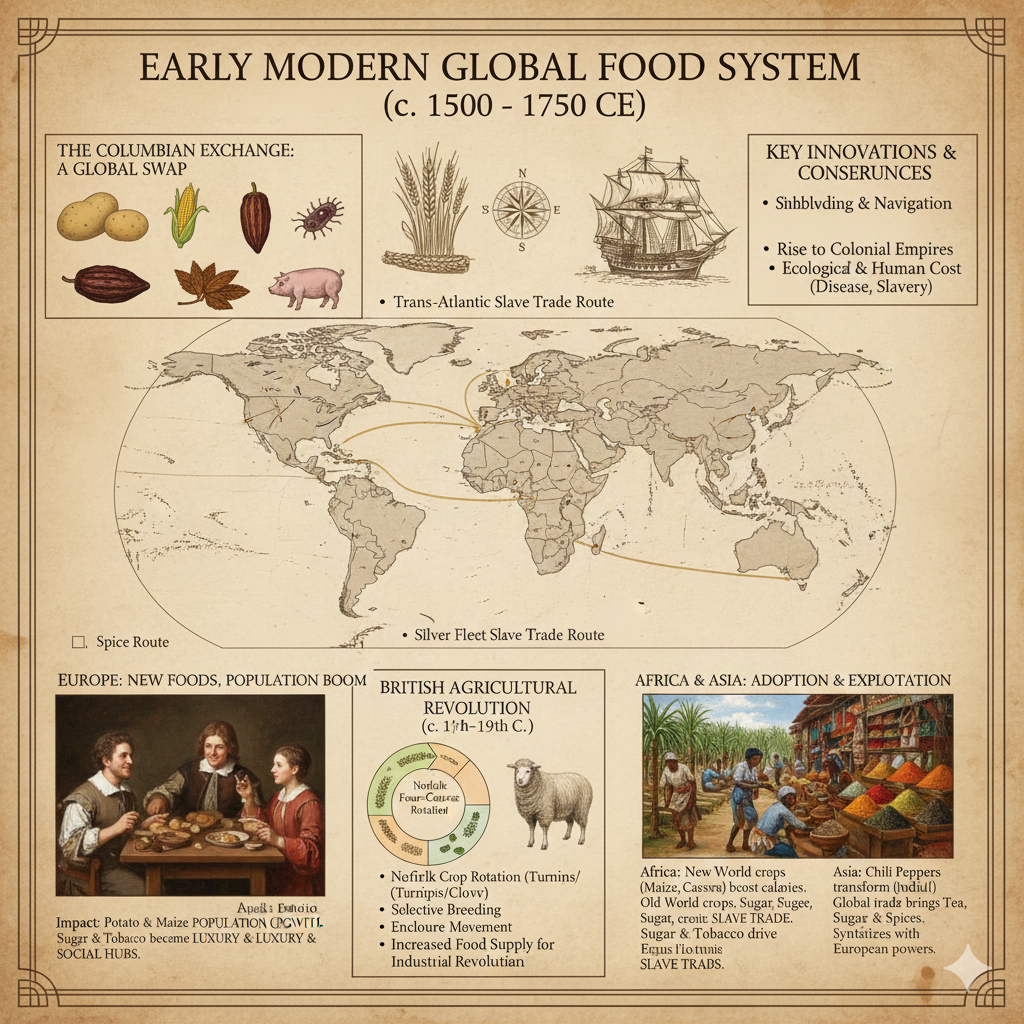
The Columbian Exchange was the widespread transfer of plants, animals, culture, human populations (including slaves), technology, diseases, and ideas between the American continents (New World) and the Old World (Europe, Africa, and Asia) in the 15th and 16th centuries, following Christopher Columbus’s 1492 voyage.
The staple crops of potatoes, maize (corn), and cassava were arguably the most important transfers. They were high-calorie, nutritious, and could grow in diverse climates, helping to prevent famine in Europe, Africa, and China. Tomatoes, peppers (including chili peppers), squash, and pumpkins became integrated into nearly every global cuisine. Cash Crops: Tobacco and cacao (the source of chocolate) became highly valuable commodities that drove early global trade.
The lack of large domesticated animals in the Americas meant the Old World animals were quickly adopted and transformed the landscape. Cattle, horses, pigs, sheep, and goats were introduced. Horses revolutionized transportation, warfare, and hunting for Native American tribes, particularly on the Great Plains. Pigs and cattle became crucial new protein sources. European settlers introduced their staple foods to sustain their colonies such as wheat, barley, rye, and rice (including African varieties, often brought by enslaved people).
The vast flow of new commodities and precious metals (like silver) from the Americas powered the rise of European mercantilism and early global capitalism. But Native American populations declined by 50% to 90% due to diseases to which they had no resistance, profoundly destabilizing societies and clearing the way for European colonization. The massive death toll among Native American populations created a severe labour shortage for the newly established plantations (especially sugar, cotton, and tobacco). This demand directly fueled the Transatlantic Slave Trade, forcibly bringing millions of Africans to the Americas.
In Britain, Although initially met with suspicion, the potato was introduced to Britain in the late 16th century (often associated with explorers like Sir Walter Raleigh). Over the next two centuries, the potato became a crucial staple for the working class, particularly in Ireland and parts of Scotland. It offered significantly more calories and vitamins per acre than wheat or barley, providing a vital source of cheap energy that helped support a growing population and stave off famine. The new American crops (especially the potato) allowed British farming to be far more productive, raising the floor for the poorest citizens and reducing reliance on expensive wheat and meat. Maize was used principally as animal fodder.
The tomato arrived in Britain in the mid-16th century. Like the potato, it was initially viewed with great suspicion, largely because it belongs to the deadly nightshade family. It was first grown as an ornamental plant. It wasn’t until the 18th century that it was widely accepted for consumption, after which it became indispensable to British and European cuisine.
Chocolate was introduced to the elite classes in the 17th century, first as a bitter beverage and later as a sweetened drink. It grew from an aristocratic novelty to a popular indulgence. Introduced quickly, tobacco use exploded, becoming a massive cash crop and a staple of colonial trade that fundamentally changed social habits.
The Second Agricultural Revolution
The adoption of New World crops, particularly the high-calorie potato, increased overall land productivity and provided a cheap, resilient food source for the growing working class. A rapidly increasing British population (especially in cities due to early of industrialisation) created an enormous and urgent market demand for cheap, reliable food, driving farmers to maximize their productivity.
It was one of the drivers of the British Agricultural Revolution between the 17th and 19th centuries, when the application of science, technology, and economic principles to increase food production efficiency, provided the foundation for the Industrial Revolution. A series of Parliamentary acts consolidated scattered, communal land into large, private, fenced fields (enclosures). This stripped small farmers of their common rights but incentivised large landowners to experiment and invest heavily in the new, profitable farming methods.
The most important change was the replacement of the medieval fallow year with fodder crops. Under the Norfolk Four-Course Rotation system, the rotation was: 1) Wheat (cash crop); 2) Turnips (winter feed for livestock); 3) Barley (cash crop); 4) Clover/Grass (nitrogen-fixer and summer feed) This innovation eliminated wasted land, restored soil fertility (via clover), and allowed farmers to keep more livestock through the winter. Inventions like Jethro Tull’s seed drill (1701) helped plant seeds in neat rows, reducing waste and increasing efficiency.
Alongside this, figures like Robert Bakewell pioneered selective breeding as a scientific practice, deliberately mating animals with desirable traits (e.g., larger sheep, heavier cattle) to increase the size and yield of livestock.
Countries like France, Germany, and the Netherlands began adopting similar systems in the late 18th and early 19th centuries, but it was slowed because land was still held under communal or feudal arrangements well into the 19th century. German states were particularly advanced in applying chemistry to farming, pioneering early forms of chemical fertilizers in the 19th century. The United States and Canada adopted the principles quickly, especially after the mid-19th century. The US had vast, open land, making the large-scale, mechanized farming principles of the revolution (which eventually led to inventions like the reaper) essential and highly effective. They adapted New World crops (like corn) into efficient rotations.
The Industrial Revolution
These changes, combined with mass migration to the cities, where the urban masses could not grow their own food, had the effect of decoupling the majority of the population from food production.
While food became more available, the diet of the urban working class became monotonous and often deficient. The diet of the urban poor centered on three cheap staples: bread, tea, and potatoes. Potatoes: werethe cheapest, most energy-dense food source, crucial for feeding large families. Tea became a ubiquitous and cheap beverage, consumed constantly, often heavily sweetened with imported sugar (a product of the global colonial system and slave labour).
Traditional garden vegetables and foraged foods disappeared from the urban diet. The consumption of meat dropped significantly for the poor, as high-quality cuts were expensive. The monotonous, heavily carbohydrate-based diet, low in protein and fresh vitamins, led to widespread malnutrition diseases like rickets (vitamin D deficiency) and scurvy (vitamin C deficiency) among the factory workers.
The mass production of cheap food for profit led to rampant food fraud, and adulteration, creating a public health crisis.
The Industrial Revolution provided the technology to move food faster and preserve it longer. Steam engines, canals, railways, and eventually steamships, allowed food to be moved vast distances. Britain began importing large quantities of cheap American grain, particularly after the repeal of the Corn Laws in 1846. The invention of canning in the early 19th century (originally to feed Napoleon’s army) allowed meat, vegetables, and fruit to be preserved for long periods, which was essential for feeding the Navy, the Army, and later, the urban populace. While fully effective mechanical refrigeration arrived later in the 19th century, earlier experiments paved the way for the import of fresh meat from Australia and South America, completely changing the meat supply chain by the 1880s.
Companies began placing their names (brands) on packages as a promise of consistent quality and safety. This practice—pioneered by companies like H.J. Heinz (“57 Varieties”) and Quaker Oats—allowed consumers to select a trusted product without having to inspect it themselves. The brand became a crucial marketing tool for building consumer confidence. The proliferation of cheap, mass-produced newspapers and magazines in the late 19th century allowed food manufacturers to use national advertising campaigns to build brand recognition, often appealing directly to housewives with promises of convenience, purity, and scientific nutrition.
Gemini AI helped me with this. Its sources include:
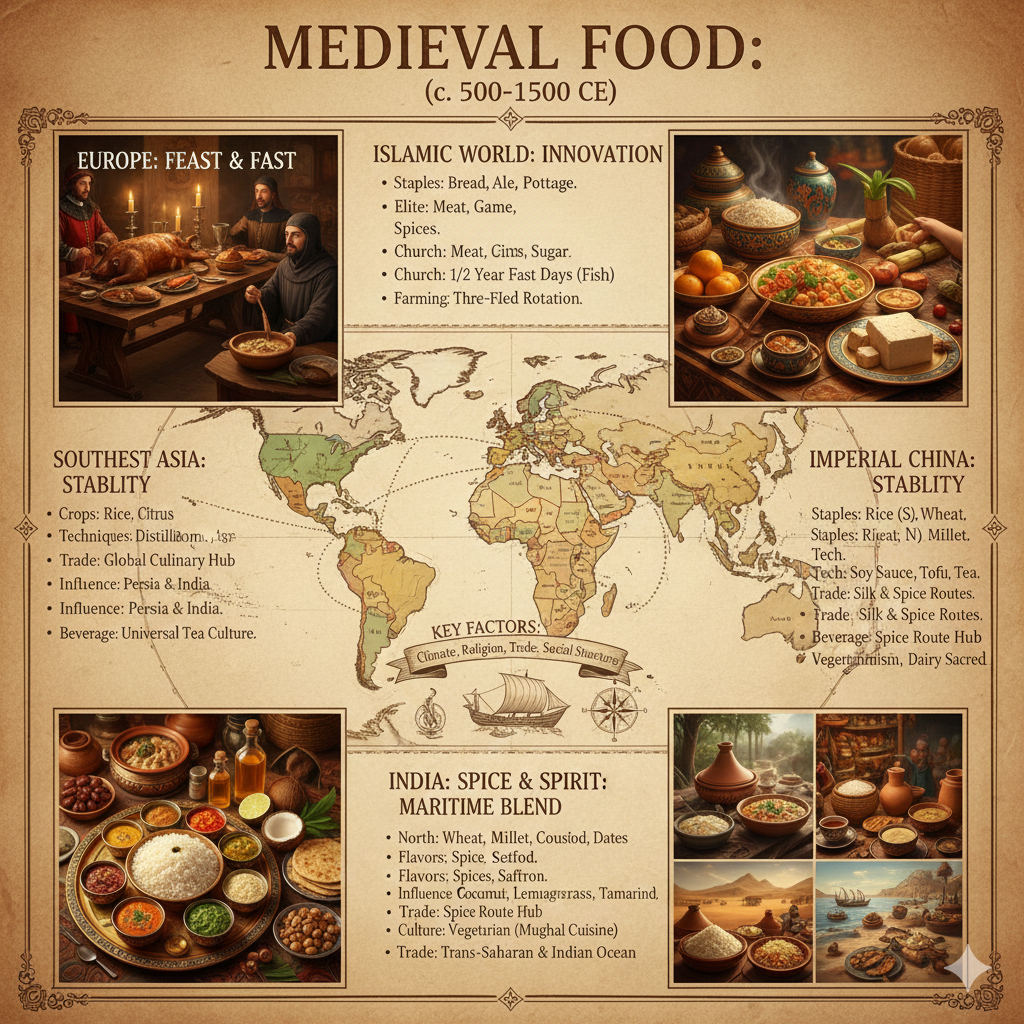
European food during this period was defined by the feudal system, the dominance of the Catholic Church, and limited transportation infrastructure.The Catholic Church exerted massive control over the diet. Fasting days (Lent, Advent, Fridays, and vigils) meant that for nearly half the year, the consumption of all warm-blooded animals and their products (milk, butter, cheese) was forbidden. This led to a huge reliance on fish (both fresh and salted cod/herring) and created a distinct, non-meat-based cuisine for half the year.
The primary technical change was the widespread adoption of the three-field crop rotation system (winter crop, spring crop, fallow), which improved yields compared to the older two-field system and better sustained the growing population.
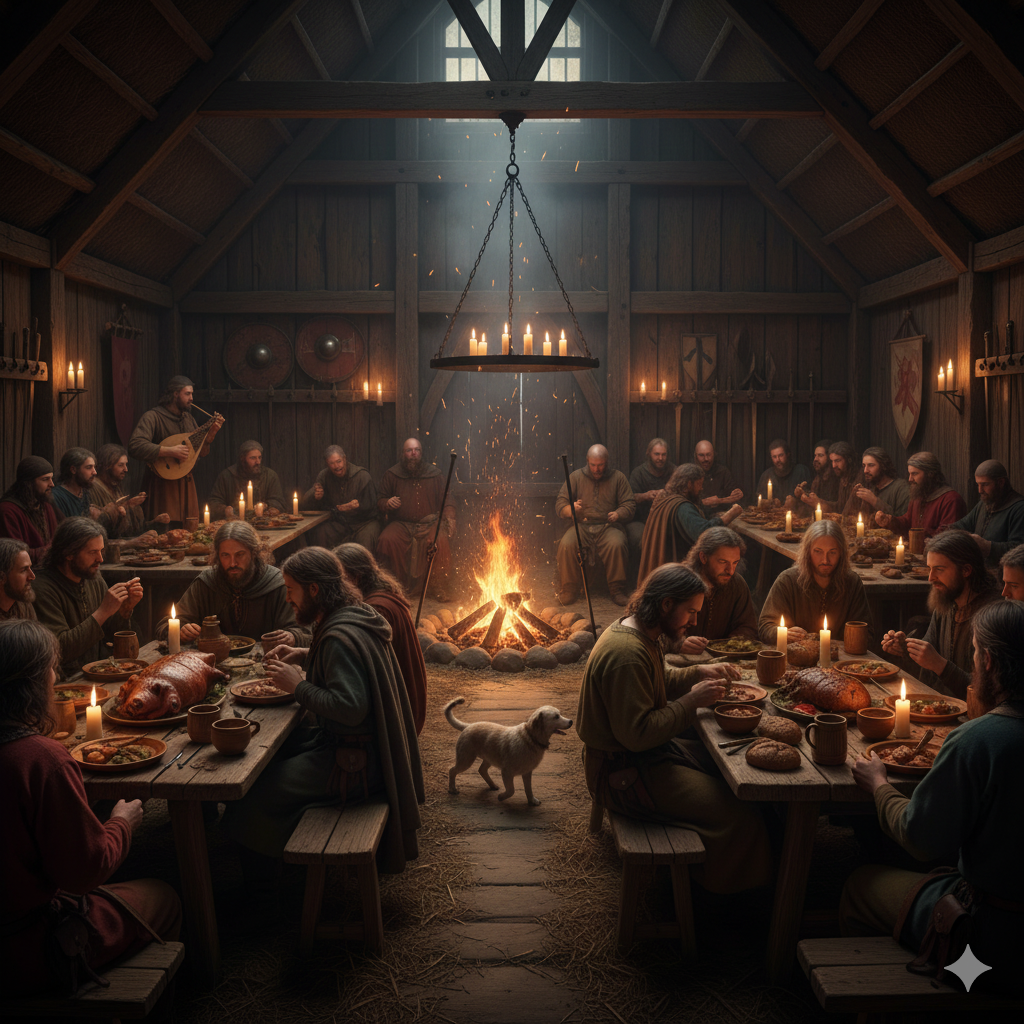
But the most notable change, especially under the Norman feudal system was the establishment of a heavily tiered system of consumption. The Elite (Nobility and Clergy) consumed a highly protein-rich diet dominated by meat (venison, boar, beef, swan) and fish (especially during fasting days). Their meals were heavily seasoned with expensive imported spices (ginger, cinnamon, cloves, pepper) used as much to signal wealth as to flavour food.
For commoners, diets were reliant on staples that could be grown locally, overwhelmingly centred on cereals (especially barley, rye, and oats) and pulses (peas and beans). The main daily meal was pottage—a thick stew made of water, grain, and whatever vegetables or wild herbs were available. Bread (often coarse and dark) and ale (the universal, low-alcohol beverage) were consumed daily. Meat was rare, often limited to pigs, poultry, or small game.
The Black Death (1347–1351 CE) caused a sudden, massive change in the European diet due to a demographic collapse. With up to half the population dead, land became abundant and labour scarce, so peasant survivors could demand higher wages and better land. This sudden wealth meant less reliance on cheap grains and more consumption of luxury foods, particularly meat and dairy. Many fields were converted from grain production to less labor-intensive pasturage for livestock.
Outside of Europe, powerful empires and established trade routes facilitated dietary diversification and culinary innovation, largely uninterrupted by feudalism.
Islam
The Islamic Caliphates (Middle East, North Africa, and Al-Andalus/Spain) were at the forefront of agricultural and culinary development during Europe’s Middle Ages. They introduced or refined sophisticated irrigation techniques, allowing for intensive farming in arid climates. They introduced new crops into the Mediterranean and beyond, notably sugar cane, rice, cotton, citrus fruits (lemons, oranges, limes), and several new vegetables and herbs (e.g., aubergine, spinach). Islamic cuisine saw the development of complex techniques and flavors, including pastry making, distillation (alcohol and essences), and refined sweets. Dishes involved layering flavors and were far more sophisticated than contemporary European fare.
Asia
Food in China during the Medieval period (e.g., Tang and Song Dynasties) was characterised by stability, urbanisation, and technological advancement. The primary staple remained rice in the South and wheat and millet in the North. Sophisticated technologies for food preservation (like soy sauce, tofu, and various fermented pastes) were highly refined, stabilising the diet of large urban populations. The widespread adoption of tea as the national beverage for all social classes helped sanitise drinking water and became a major trade commodity.
India’s staples were determined by climate: in the North and Northwest, wWeat (often consumed as flatbreads like roti and chapati), barley, and millet were the major staples, supplemented by dairy. In the South and East, Rice was the dominant staple, thriving in the monsoon climate. Rice was consumed boiled, steamed, and fermented into batters (like idli and dosa). Dals (lentils and legumes) were a universal staple across all regions, providing essential protein and being consumed daily.
Conquerors and traders from the Middle East and Central Asia introduced entirely new cooking styles and ingredients, laying the foundation for modern North Indian and Pakistani cuisine. New Cooking Techniques like dum pukht (slow steam cooking) and the use of the tandoor (clay oven) became widespread. They brought culinary concepts like korma (braising meat in yogurt and cream), biryani (layered rice and meat/vegetable dishes), and various forms of kebabs.
Food and diet in India were profoundly shaped by religious customs and the established caste system, including widespread adoption of vegetarianism and near-universal consumption of dairy products. There was a massive increase in the use of dry fruits (almonds, pistachios, raisins), saffron, and richer dairy products (like ghee and cream) in savory preparations, distinguishing courtly cuisine from peasant food. India was a major hub of global trade, allowing sugar and spices to be exported, and new foods to arrive via sea and land routes.
South East Asia was the source of many global spices, such as cloves and nutmeg, and used local ingredients like lemongrass, galangal, lime leaves, and tamarind to build complex sour and sweet flavours. Food was almost universally built on wet-rice cultivation and had a massive reliance on seafood and fish as the primary source of protein. Umami was derived almost entirely from fermented fish products, such as fish sauce (similar to the garum of the Romans) and various fish and shrimp pastes. This gave the cuisine a distinct, pungent, and savoury profile. As the middle ages went on, the area was increasingly influenced by Chinese, Indian and Islamic cuisine.
America
In the Americas, food systems continued to be based on the local staples, entirely independent of the Old World. The diet was built upon the “Three Sisters” system: Maize (corn), Beans, and Squash. Maize was processed using nixtamalisation (treating it with an alkaline solution) to make its nutrients bioavailable. Protein Sources: Protein came from domesticated animals like turkeys and dogs, along with fishing and hunting.
Africa
Medieval Africa was characterised by fragmented culinary regions. North Africa was heavily integrated into the Mediterranean and Islamic food sphere, East Africa became a gourmet blend due to Indian Ocean trade, while the interior regions maintained resilient food systems based on locally adapted crops like yams, millet, and sorghum. Cattle were hightly valued in the south, and fermented dairy was widely consumed.
Gemini AI helped me with this. Its sources include:
The period from the first tool-making hominins (2.5 million years ago) to the end of the last Ice Age (12,000 years ago) is known as the Paleolithic Era. The primary dietary strategy during this time was hunting and gathering.
Fire: The First Culinary Revolution
Control of fire by Homo erectus (possibly as early as 1.5 million years ago) was perhaps the single greatest culinary and social innovation.
Nutritional Advantage: Cooking food (meat and starchy tubers) makes it easier to chew and digest. Crucially, cooking denatures proteins and unlocks nutrients, making more calories available for absorption. This higher-quality diet provided the massive energy necessary to fuel the growth of the human brain.
Social Structure: Fire provided warmth, protection from predators, and a focal point for social activity, lengthening the day and allowing for more time dedicated to tool-making and social bonding.
The Hunter-Gatherer Diet
Early hominins were highly opportunistic, but as brain size increased, the importance of nutrient-dense food grew.
Hunting: While early hominins likely scavenged, skilled, cooperative hunting became a hallmark of later species, particularly Homo sapiens. Hunting provided essential protein and fat.
Gathering: Gathering provided the bulk of the calories, offering diverse plant foods (roots, berries, nuts, seeds), which were essential for dietary stability, especially in times when hunting was unsuccessful.
Dietary Flexibility: This deep reliance on both hunting and gathering instilled a profound dietary flexibility that allowed humans to successfully colonize nearly every environment on Earth.
Out of Africa and the Ice Age Migrations
From 100, 000 years ago, modern humans, Homo sapiens, began migrating out of Africa in major waves, spreading across Asia, Europe, and eventually the Americas and Australia.
Migration to Britain and Doggerland
Glacial Cycles: The migration into Britain was episodic, tied directly to the great Ice Ages (Pleistocene). During colder periods, massive ice sheets covered much of northern Britain, and sea levels dropped dramatically as water was locked up in ice.
The Neolithic Revolution (The Birth of Farming)
The end of the last Ice Age brought a warmer, more stable climate, leading to the Neolithic Revolution—the shift from foraging to food production (farming).
The Fertile Crescent and Global Spread
Domestication: This revolution began in the Fertile Crescent (the Middle East) around 12,000 years ago, where wild grasses like wheat and barley were first domesticated. The key was selecting for traits like non-shattering seed heads and increased seed size.
Dietary Change: The diet shifted to be heavily reliant on cereals (carbohydrates) and domesticated animals (sheep, goats, cattle, pigs).
Pros and Cons: Farming allowed for sedentary living and supported larger populations. However, the diet became less diverse, often leading to nutritional deficiencies, while living in close proximity to animals and dense populations led to the rapid spread of infectious diseases.
Farming Arrives in Britain
Around 4,500 BCE (6,500 years ago): Farming technologies spread across Europe and finally reached Britain, replacing the existing Mesolithic (Middle Stone Age) hunter-gatherer lifestyle.
Early British Farmers: These Neolithic farmers introduced domesticated animals and crops, leading to deforestation as land was cleared for fields. Diet shifted to include domesticated cattle, pigs, and sheep, alongside wheat and barley. They were also responsible for building massive communal monuments like Stonehenge.
Fermentation: A Pre-Agricultural Discovery
While often associated with farming, the art of fermentation likely predates the Neolithic period.
Natural Fermentation: Accidental fermentation of naturally sweet liquids (like overripe fruit or honey mixed with water) was likely discovered by hunter-gatherers.
Purposeful Production: With farming, the intentional fermentation of grains became widespread. Beer and simple wines were easier to store, and the fermentation process made them safer to drink (as boiling water was used and alcohol inhibits bacteria). Beer became a significant source of nutrition and calories in early farming societies.
The Metal Ages
The Neolithic period was followed by the Bronze Age and the Iron Age, marked by the adoption of metallurgy.
Bronze Age (2,500 to 800 BCE)
Food Production: Farming continued to intensify. The diet remained cereal- and livestock-based.
The Beaker Culture: The arrival of the Beaker people in Britain around 2,500 BCE saw a shift in burial practices, the introduction of copper/bronze working, and possibly the introduction of new farming and brewing techniques.
Iron Age (800 BCE to 43 CE)
Celtic Fields: Iron tools enabled more efficient forest clearance and deeper ploughing. The landscape became dominated by small, square fields, often called “Celtic fields.”
The diet remained centered on cereal crops and livestock, but farming became more efficient:
The main staples were barley and wheat (especially emmer and spelt). These were often consumed as porridge or gruel (pottage) and sometimes as flatbreads. Iron tools allowed for more efficient ploughing and harvesting, which increased yields. Peas, beans, and lentils were crucial for providing protein and for restoring nitrogen to the soil via crop rotation. The introduction of the heavy plough (though possibly later in the period) could turn over heavy clay soils, enabling larger-scale production in previously unmanageable areas.
The Iron Age diet was generally rich in animal products, especially compared to later Medieval diets: Cattle, sheep, and pigs were the primary livestock. Cattle provided meat and hides, but their most important contribution was dairy (milk, butter, and cheese) and their use as draught animals (for pulling ploughs). While organized farming provided the bulk of the food, hunting of wild boar, deer, and fowl continued to supplement the diet, often as a source of prestige. Consumption varied significantly by region, but coastal and riverside settlements relied heavily on fish, shellfish, and seals.
The Iron Age saw developments in food storage that stabilized the food supply and allowed for surplus, which was crucial for supporting larger populations and fortified sites. Grains were stored in underground, bell-shaped pits called souterrains or in granaries built on posts (four-post structures). These pits helped keep the grain cool and dry, or, in some cases, preserved by fermentation.
The rise of large, defended settlements, such as hill forts, suggests that food resources and livestock were increasingly centralized and needed protection from competing tribes. The ability to store large grain reserves was essential for these communities.
Fermented beverages remained central to the diet: main drink was a thick, unfiltered ale brewed from barley or wheat. This provided hydration, calories, and was often safer to drink than local water. A fermented drink made from honey, mead was likely reserved for special occasions or the tribal elite.
Roman Rule and Germanic Tribes
Roman conquest introduced new crops and infrastructure that stabilized and diversified the food supply.
Roman Britain (43 CE to 410 CE)
The Roman occupation of Britain (43 CE to 410 CE) introduced major, lasting changes to the food system, particularly in the range of non-meat crops and culinary techniques, transforming the simple Iron Age diet.
The Romans significantly diversified the range of plant foods available, especially vegetables, fruits, and herbs previously unknown or uncommon in Britain. These included cabbage, carrots, parsnips, turnips, cherries, plums, grapes, walnuts and chestnuts.
New herbs included mint, thyme, parsley, coriander, and dill. Essential Roman condiments like liquamen (fermented fish sauce, similar to modern Southeast Asian fish sauce) and garum were imported and used widely by the Romanized population to flavor almost all dishes. Olive oil, imported from the Mediterranean, became a staple fat for cooking and seasoning, replacing animal fats in many Roman-style dishes. Wine became the standard beverage for the elite and was produced in small quantities in Roman villas in the south of England.Condiments included
They also brought new farming tools (like the heavy plough) and industrial-scale grain production. They introduced better-yielding varieties of wheat, such as spelt and a form of bread wheat, enabling the production of lighter, finer bread favored by the Romans and the elite. The Romans introduced advanced water mills and rotary querns for grinding grain, leading to more efficient and higher-quality flour. Particularly in military forts and towns, this resulted in food preparation moving from small domestic units to industrial operations,
Roman villas and towns featured purpose-built kitchens with sophisticated ovens and hearths, allowing for a wider range of baking and roasting methods beyond the simple open fires of Iron Age roundhouses.
These new foods and techniques created a massive gap in diet. The Romanized urban elite and military consumed a varied, Mediterranean-style diet, while the majority of the rural native population continued to rely on traditional Iron Age staples (porridge, gruel, coarse bread, and local meat/dairy), though they gradually adopted some of the new crops like cabbage and turnips.
Anglo-Saxon England
With the end of Roman rule, many of the Roman imports and specialized crops either vanished or were relegated to small monastic gardens. Wine and olive oil disappeared. Ale and mead saw a resurgence. Traditional Northern European staples were re-emphasized and there was a decisinve shift away from the specialized, urban, and diverse Roman diet.
The introduction and focus on Barley and Rye became paramount, often replacing Roman bread wheat in the common diet. Barley was the primary grain for brewing, while rye was hardy and used for darker, coarser bread. Oats were also vital for animal feed and human consumption (porridge).
The use of the heavy, wheeled plough became more widespread. While the Romans used simple ploughs, the Anglo-Saxon plough was better suited for the deep, heavy soils of Britain, leading to the development of the distinctive open-field system of agriculture.
Once again, milk, butter, and especially cheese were central to the diet, providing fat and protein that could be stored through the winter. Cows were highly valued for dairy and labour more than for meat. but pigs were particularly important as they could be fed on woodland forage (acorns and mast) and their meat (pork and bacon) was easily preserved by salting and smoking. Honey was the primary sweetener, replacing imported sugar.
Gemini AI helped me with this. Its sources include:
The earliest evidence of life suggests simple, single-celled organisms appeared around 4 billion years ago. For the first billion years, life was anaerobic, thriving in the oxygen-poor atmosphere of early Earth.
The process of how life began on Earth, called abiogenesis, involves a chemical progression from non-living matter to the first simple cells.
Primordial Soup: Early Earth’s atmosphere, energized by lightning and UV radiation, spontaneously formed simple organic molecules (monomers) like amino acids, as demonstrated by the Miller-Urey experiment. These dissolved in the oceans.
Polymers: These monomers were concentrated and linked together into complex polymers (proteins and nucleic acids) in environments like hydrothermal vents or on mineral surfaces.
RNA World: The RNA World Hypothesis suggests that RNA was the first life molecule. RNA is unique because it can both store genetic information and catalyze reactions (like a protein), solving the “chicken-and-egg” problem of modern DNA/protein life.
Protocells: Finally, these self-replicating RNA systems were enclosed within simple lipid membranes (protocells), separating their internal chemistry from the environment and marking the transition to the first living organisms.
Weather
The transition to the current, oxygen-rich atmosphere began about 2.7 billion years ago with the evolution of photosynthesizing bacteria (also known as cyanobacteria or blue-green algae). These organisms consumed CO2 and released Oxygen (O2) as a waste product. This biological process slowly built up free oxygen, culminating in the Great Oxygenation Event. This event was catastrophic for most existing anaerobic life but paved the way for the evolution of oxygen-dependent (aerobic) organisms.
Today, weather occurs almost entirely in the troposphere, the lowest layer of our atmosphere. It is driven by the interaction of solar energy heating the surface, the presence of water vapor (a powerful greenhouse gas), and the resulting differences in temperature and pressure, which create wind, clouds, and precipitation.
Multicellularity
The increasing oxygen levels allowed for the evolution of more complex cells. Eukaryotes and Multicellularity: By about 1.5 billion years ago, eukaryotic cells (with internal nuclei and organelles) emerged. True multicellularity appeared later, allowing for larger, differentiated organisms like algae to evolve in the oceans.
Land, Soil, Forests
Life remained largely aquatic until the Ordovician and Silurian Periods (around 485 to 419 million years ago). Simple, non-vascular plants, similar to mosses and liverworts, began colonizing the continents, stabilizing soils and fundamentally changing the terrestrial environment.
Soil is formed over thousands of years, as rocks are broken down by weathering, chemical reactions and biological effects. As mineral fragments accumulate, living organisms begin to colonize the surface. Plants grow, die, and decay, and their remains (along with animal waste and bodies) are broken down by microbes, fungi, and detritivores (like earthworms). This decomposed material becomes humus (organic matter), enriching the soil with nutrients, improving water retention, and contributing to soil structure.
The evolution of vascular tissue (xylem and phloem) around 400 million years ago allowed plants to transport water and nutrients efficiently, enabling them to grow taller and further away from water sources. This led to the formation of the first true forests during the Devonian Period (e.g., ferns, clubmosses, and early seed plants).
Grass
The earliest known grass fossils, found in the form of microscopic silica bodies called phytoliths (in ancient soil and even dinosaur coprolites), date the origin of grasses back to the Early Cretaceous Period, approximately 113 to 100 million years ago. At this time, they were likely small, shade-tolerant plants growing on the fringes of forests, similar to modern bamboo relatives.
Grasses became ecologically significant much later. Following the mass extinction at the end of the Cretaceous (66 million years ago) and throughout the cooler, drier climate periods of the Cenozoic Era (Paleogene and Neogene), grasslands began to spread widely.
The development of the more water-efficient C4 photosynthesis pathway in many grass species (starting around 30 million years ago and expanding greatly in the last 15 million years) allowed them to become dominant. As the climate became drier and cooler starting around 35 million years ago, vast grasslands and savannas began to replace dense forests, particularly across North America, Africa, and Asia.
Mammals: Grazers and Apes
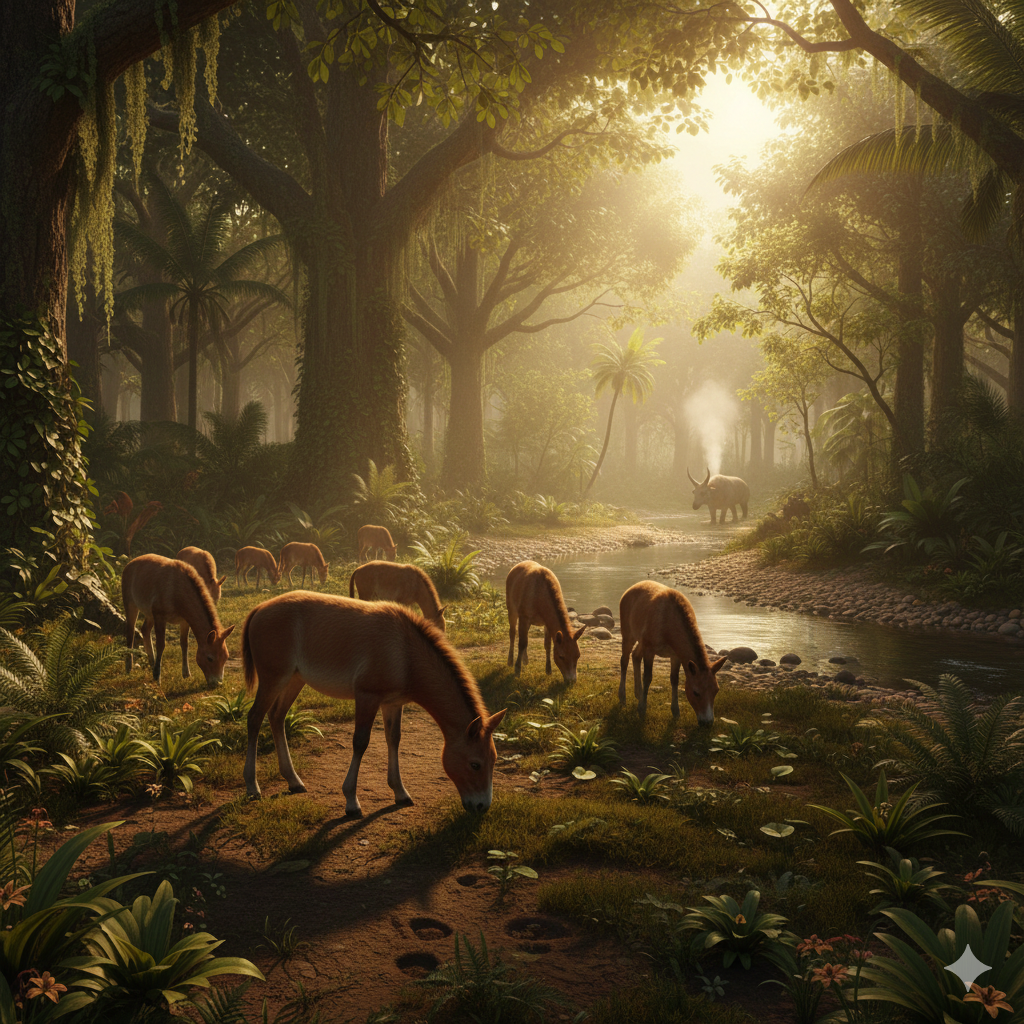
The expansion of grasslands drove a spectacular evolutionary arms race. Herbivores, such as early horses and camels, evolved High-crowned teeth (hypsodonty) to grind down the abrasive silica-rich leaves of grass; Specialized digestive systems to break down cellulose; Longer legs for swift running across open plains to escape predators.
The Miocene Epoch (about 23 to 5.3 million years ago) is often called the “Golden Age of Apes.”
The earliest great ape ancestors (Hominoids), such as Proconsul, flourished in Africa during the early and middle Miocene (around 20–10 million years ago). These were generally generalized, tree-dwelling primates that thrived in the widespread Miocene forests.
As the climate dried and forests fragmented, many ape lineages either went extinct or adapted to more open, mixed woodland/grassland environments. This pressure ultimately led to the divergence of the lineages leading to modern great apes (orangutans, gorillas, chimpanzees).
Around 6 to 7 million years ago, the divergence occurred between the ancestors of chimpanzees and the earliest hominins.
The critical transition was the evolution of bipedalism (walking upright on two legs), exemplified by genera like Ardipithecus and Australopithecus (e.g., “Lucy,” 3.2 million years ago). Bipedalism is theorized to have been advantageous on the increasingly open savannas, allowing hominins to see over tall grasses and travel more efficiently between dwindling forest patches.
The universe began approximately 13.8 billion years ago with the Big Bang, an event describing the rapid expansion of space from an extremely hot, dense state. In the first fraction of a second, the universe underwent a phase of Cosmic Inflation, an exponential expansion that smoothed the cosmos and laid the foundation for the large-scale structure we see today.
The Laws of Physics
In the immediate aftermath of the Big Bang, the universe was an incredibly hot, dense plasma of fundamental particles. The laws of physics as we know them, including the four fundamental forces—gravity, electromagnetism, and the strong and weak nuclear forces—are thought to have separated and taken on their current forms as the universe rapidly cooled. Before this cooling, all forces may have been unified. The current structure of the universe, including the ratios of matter and energy, is explained by the actions of these forces operating from this early epoch.
Creation of Elements
A few minutes after the Big Bang, the temperature dropped low enough for protons and neutrons to fuse in a process called Big Bang Nucleosynthesis (BBN). This created the first, and lightest, elements: Hydrogen (about 75% of the total mass) and Helium (about 25%), along with trace amounts of Lithium.
All of the heavier elements essential for life and planets (like carbon, oxygen, and iron) were created much later in the cores of stars and scattered through the universe by supernova explosions.
All elements heavier than Helium were forged much later inside stars and during their explosive deaths, a process called stellar nucleosynthesis.
Lighter Elements (up to Iron): Stars sustain themselves by fusing lighter nuclei into heavier ones in their cores. Smaller stars fuse hydrogen into helium, while massive stars can continue this process through the CNO cycle and successive burning stages, creating elements up to Iron (Fe)—the most stable nucleus.
Heavier Elements (beyond Iron): Elements heavier than iron, such as gold, silver, and uranium, are created during catastrophic events like supernova explosions and neutron star mergers. The immense energy and dense flux of neutrons during these events trigger rapid neutron capture processes (r-process), building the heaviest nuclei. This expelled stellar material enriches the interstellar medium, providing the building blocks for new stars, planets, and life.
Creation of the Earth
The creation of complex structures, including planets, was a late event in cosmic history, occurring roughly 9 billion years after the Big Bang. Our solar system began to form about 4.6 billion years ago from a massive, rotating cloud of gas and dust called the solar nebula. This nebula consisted of the primordial hydrogen and helium, enriched by heavy elements produced by earlier generations of stars.
The Earth formed approximately 4.54 billion years ago through the process of accretion, where dust and rock particles in the young solar system’s nebula collided and clumped together under gravity. This process generated immense heat, causing the early Earth to be largely molten. As it cooled, denser materials sank to form the core, while lighter materials rose to form the mantle and the earliest, thin crust.
The permanent, buoyant continental crust began to form about 4 billion years ago. This crust is chemically distinct from the denser oceanic crust and is created primarily through volcanic activity, where basaltic rocks are partially melted and chemically processed, often at early subduction zones. The oldest parts of these early continents are called cratons, which remain the stable cores of modern landmasses.
Almost all igneous rocks are composed predominantly of silicate minerals, meaning the essential ingredients are Silicon (Si) and Oxygen (O). The other major elements, or “building blocks,” that determine the specific type of igneous rock formed include: aluminum, iron, calcium, sodium, magnesium and potassium. The ratio of these elements, especially the percentage of silica (SiO2), determines the rock’s mineralogy, color, and density. Coarser grained (plutonic) rocks come from magma from deep in the earth’s crust. Finer grained rocks come from lava from volcanoes. Sedimentary rocks are formed from weather erosion, deposition and compaction. Metamorphic rocks, such as marble and slate and formed when existing rocks are pulled down under the crust.
Continents and Oceans
The arrangement of the continents is not static; it is dictated by Plate Tectonics. The Earth’s rigid outer layer (the lithosphere) is broken into large plates that float and move slowly over the semi-molten mantle below. Over billions of years, this movement has caused continents to periodically collide and fuse into vast supercontinents, only to break apart again.
For example, around 335 million years ago, nearly all landmasses assembled into the supercontinent Pangaea (“All Lands”). Starting about 175 million years ago, Pangaea began to break up, slowly drifting its fragments—which became today’s continents—into their current positions, a process that continues today.
The creation of Earth’s oceans is thought to have resulted from a combination of processes that occurred as the planet cooled about 4.5 to 3.8 billion years ago.
The main source of water was volcanic outgassing (H2O vapour and other gases released from the Earth’s interior through constant volcanic eruptions). As the Earth’s surface cooled below the boiling point of water, this water vapor in the atmosphere condensed, leading to centuries of torrential rain that filled the low-lying basins.
A contributing source was likely the delivery of water by icy asteroids and comets that bombarded the early Earth. Current scientific consensus suggests that water was both native to the Earth’s original formation materials and delivered later by impactors, resulting in the vast, life-sustaining oceans we have today. Evaporating water absorbs carbon dixide from the atmosphere, making it slightly acidic. When it falls as rain, it dissolves sodium from silicate minerals in igneous and metamorphic rocks, causing saline build-up in the oceans.
Atmosphere
Earth’s first atmosphere was a temporary, thin layer of light gases like Hydrogen (H2) and Helium (He), swept away almost immediately by intense solar winds and the planet’s weak early gravity. As the molten Earth cooled, intense and constant volcanic activity began releasing gases from the planet’s interior—a process called outgassing. This created the stable second atmosphere, composed mainly of Water Vapour (H2O), Carbon Dioxide (CO2), and Nitrogen (N2).
In 1885, Siegfried Bettmann of Nuremberg started importing bicycles from Europe and introduced the Triumph name a year later, and the firm started producing their own bicycles in Coventry, England. In 1902 they began producing motorcycles, and became Britain’s largest manufacturer of motorcycles by the end of WWI. Cars followed in 1923. In 1919, they acquired the Clay Lane premises of the Dawson Car Company and start producing a car there from 1923. Volumes grew through the 1920s, and gradually the focus shifted to higher quality and more sporting models. Along the way, Coventry Climax engines were adopted, and then replaced by in-house designs.
Triumph Bicycles
Triumph started as a bicycle dealer manufacturing their own in Coventry and Nuremberg from 1888 and 1896 respectively. The bicycle business was sold to Raleigh in 1932.
Years
1888-1932
Engine
n/a
Body Style
Production
Power: Weight
.
Dimensions
.
Model shown is 1921 Triumph Royal
Triumph Motorcycles
By 1902, Minerva engines were added; a tricar experiment was made in 1903. By 1907 a larger plant had produced 1,000 machines. WWI was a boost, and “Trusty Triumphs” are seen as th first modern motorycle. The business was sold in 1936.
Years
1902-36
Engine
1393/1872/2169cc S4
Body Style
Tourer, sports saloon, fabric saloon
Production
Power: Weight
.
Dimensions
.
WWI military model shown
Triumph 10/20, 13/35, 15/50
Triumph’s first car, largely designed by Lea-Francis, with a Riccardo-designed engine, body initially by Regent Carriage Co; assembled at former Dawson works in Coventry. First British car with all-round hydraulic brakes.
Years
1923-30
Engine
1393/1872/2169cc S4
Body Style
Tourer, sports saloon, fabric saloon
Production
c. 2500
Power: Weight
.
Dimensions
.
Triumph Super Seven/Eight
Those responsible for the design and devlopment included Arthur Sykes (ex-Lea-Francis) and Stanley Edge (ex-Austin 7 draughtsman). Rallied by Donald Healey.
For 1929 a new body style was released called the Special Sports with pointed tail and briefly a supercharged version reputedly able to reach 80 mph, as used in the special shown here.
Years
1929
Engine
747cc S4 supercharged
Body Style
Sports racer
Production
.
Power: Weight
.
Dimensions
.
Triumph Super Nine; Ten
Coventry Climax engine. 12v electrics. Ten got a rear-wheel handbrake. Southern Cross sports models got longer frame and eventually 1122cc.
Donald Healey’s amazing sportscar, closely modelled on the 2.3-litre Alfa, with their encouragement (a tie-up on motorcycles was mooted). Competed in 1935 Monte Carlo rally. A whole range of straight-8 cars were planned, but stillborn.
Lower and more handsome than its predecessors, and designed to be special: “quality before everying else”. Skilfully assembled from parts from around Coventry and the west midlands. Vitesse had 1476cc engine.
Years
1934-37
Engine
1087/1232cc S4
Body Style
Saloon, coupé, tourer
Production
c. 3000
Power: Weight
.
Dimensions
.
Triumph Gloria 6
Bigger engine and longer bonnet, with an extra set of louvres. Vitesse version was heavily tuned, and the body was lowered and streamlined.
Years
1934-37
Engine
1476/1991cc S6
Body Style
Saloon, coupé, tourer
Production
.
Power: Weight
.
Dimensions
.
Triumph Gloria Monte Carlo
Triumph won the light car class of the 1934 Monte Carlo rally, and celebrated with this sporty tourer.
Years
1934-37
Engine
1232cc S4; 1991cc S6
Body Style
.
Production
.
Power: Weight
.
Dimensions
.
Triumph Gloria Southern Cross
Proper 2-seater sportscar based on a shortened Monte Carlo.
Years
1934-37
Engine
12323cc S4; 1991cc S6
Body Style
.
Production
.
Power: Weight
.
Dimensions
.
Triumph (Gloria) Vitesse Free-Flow
Walter Belgrove’s contribution to the mid-1930s streamlinging fad. A graceful design but one which didn’t sell. The only survivor was for years mounted on a Bentley chassis but has now been reunited with a period Triumph chassis.
Years
1935
Engine
1476cc S4; 1991 cc S6
Body Style
.
Production
.
Power: Weight
.
Dimensions
.
Triumph Gloria/Vitesse 14; 12
Made alongside Dolomite, with more traditional styling, and on Gloria chassis, but new OHV engine. Vitesse on longer frame. 12 was the 1939 offering, on the shorter frame, and Jaguar-like grille, styling and price.
Years
1937-39
Engine
1496/1767 cc S4
Body Style
.
Production
.
Power: Weight
.
Dimensions
.
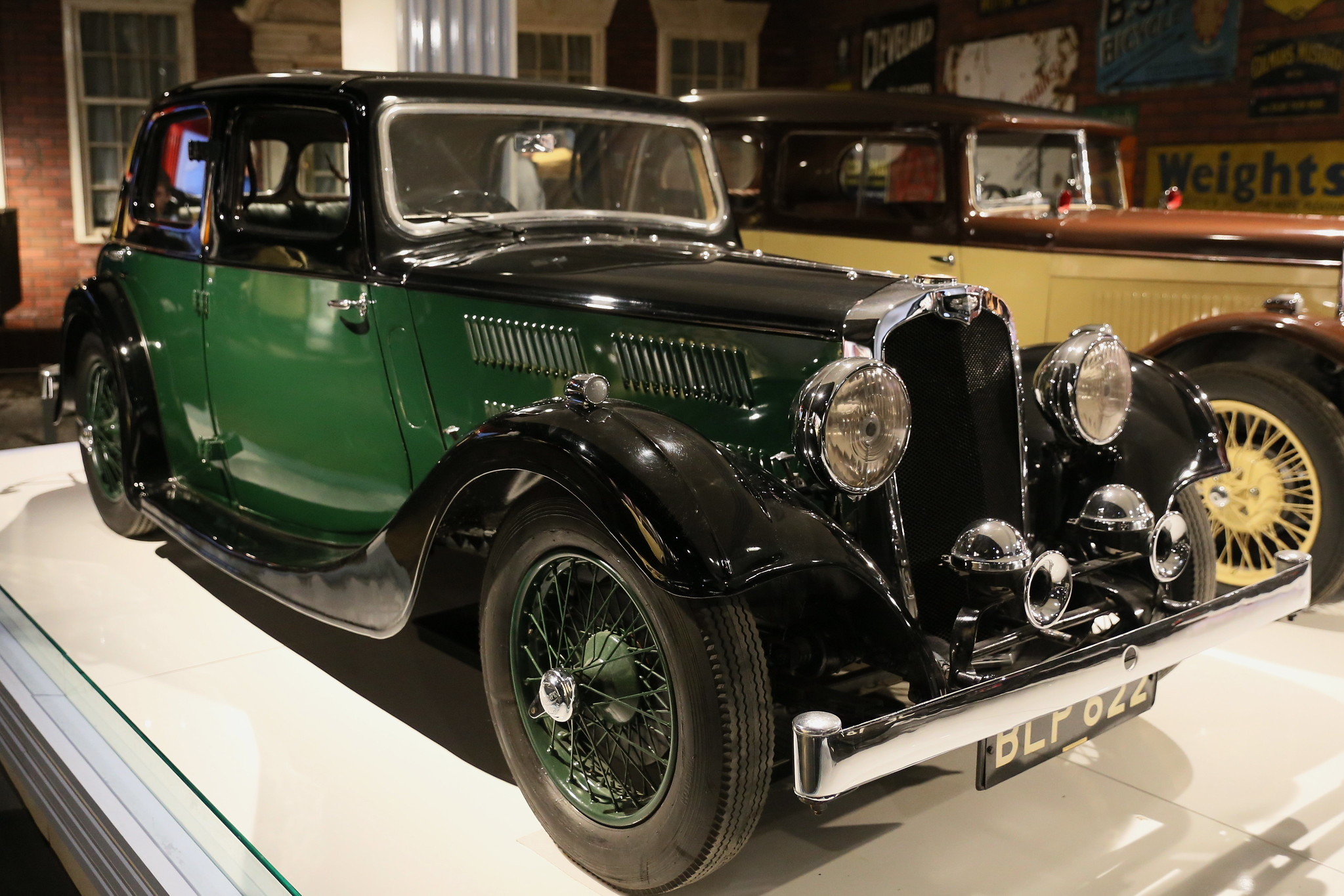
Triumph Dolomite
Design overseen by Donald Healey; styling and radiator grille by Walter Belgrove. Wider and roomier. Marketed as “the finest in all the land” luxury sporting saloons. 1.5-litre and roadster on shorter frame – latter with dickey seats.
The 18th and 19th centuries saw rapid developments in steam power, which launched the industrial revolution, and changed the world. For a few years, steam was a real contender to power road vehicles too.
Newcomen Atmospheric Engine
Balls spun by jets of steam are ancient; in 1698 Savery sold steam pressure pumps. But Newcomen’s engine produced mechanical work. Gravity pulled up a piston via a beam; vacuum pulled it down as cold water condensed steam.
Years
1712-68
Engine
Steam
Body Style
Stationary Pumping Engine
Production
Power: Weight
.
Dimensions
.
This one worked from c. 1760 to 1913 in Coventry – now a memorial in Dartmouth
Horizontal Steam Engine
Pickard in 1780 patented a crankshaft and flywheel, but for his updated design with separate condensor, Watt circumvented this with his ‘sun and planet‘ patent. Eventually, improving engineering led to horizontal engines.
Cugnot’s steam dray, the world’s first motor vehicle, weighed 2.5 t tare, and 2.8 t gross. The front wheel supported a steam boiler and driving mechanism. It could carry 4 passengers at walking pace.
Years
1770
Engine
Steam
Body Style
Dray
Production
1
Power: Weight
.
Dimensions
.
Trevithick London Steam Carriage
Assembled in London at the works of William Felton, a horse carriage builder. A coal-burning Trevithick steam engine was fitted to the rear to replace the horse. Trevithick managed to drive 8 people from Leather Lane, Holborn to Paddington. And bring them back the same day!
An evolution of three earlier locomotives by inventor and mining engineer Richard Trevithick. The first locomotive in the world to haul fare-paying passengers – at a steam circus in London.
Robert Stephenson’s clear winner in the locomotive trials for the Liverpool & Manchester Railway. A substantial advance over previous designs, with multi-tube boiler and the blast-pipe.
Years
1829
Engine
Steam
Body Style
Locomotive
Production
1
Power: Weight
.
Dimensions
.
Walter Hancock’s ‘Enterprise’ Steam Carriage
Built in London, body similar to the Shillabeer horse-drawn Omnibus with passengers sitting facing each other. Started running in 1833, carrying fare paying passengers in London and beyond. Artillery wheels, leaf springs, driven rear axle, steering wheel!
The first iron steamer to cross the Atlantic Ocean, and the largest passenger ship in the world. Designed by Isambard Kingdom Brunel for the Great Western Steamship Company’s service between Bristol and New York City.
Years
1845
Engine
Steam
Body Style
Ocean liner
Production
1
Power: Weight
.
Dimensions
.
Grenville Steam Carriage
Developed by Robert Neville-Grenville and George Jackson Churchward, built around a boiler from a Merryweather fire engine, it could carry 7 people including the driver, steersman and stoker.
Years
1875
Engine
.
Body Style
.
Production
.
Power: Weight
.
Dimensions
.
Turbinia
The first steam turbine-powered steamship – easily the fastest ship in the world at its launch. Demonstrated dramatically at the Spithead Navy Review in 1897 and set the standard for the next generation of steamships.
Built by the Liquid Fuel Engineering Co of East Cowes, Isle of Wight, who made a variety of steam boats and road vehicles from 1893.
Years
1901
Engine
Steam
Body Style
Open car
Production
Power: Weight
Dimensions.
GWR 3700 City of Truro
A 4-4-0 steam locomotive built at Swindon Works to a design by George Jackson Churchward. The first locomotive to reach 100 mph.
Years
1903
Engine
Steam
Body Style
Locomotive
Production
.
Power: Weight
.
Dimensions
.
Turner-Miesse Steam Car
Built by Turner in Wolverhampton under licence from the Brussels-based company of J. Miesse.
Years
1904
Engine
Steam
Body Style
Car
Production
Power: Weight
Dimensions
Stanley Steamer
Stanley (of Massachussetts) built cars with twin front-mounted cylinders of simple-expansion type geared directly to the rear axle, differentiating them from earlier rear-boilered cars.
Years
1910
Engine
Steam
Body Style
Car
Production
670 (in 1910)
Power: Weight
Dimensions
Burrell 5nHP The Busy Bee
Charles Burrell & Sons were builders of custom steam traction engines, agricultural machinery, steam lorries and steam tram engines, and the biggest employer in Thetford, Norfolk.
Years
1910
Engine
Steam
Body Style
Showmans Tractor
Production
670 (in 1910)
Power: Weight
Dimensions
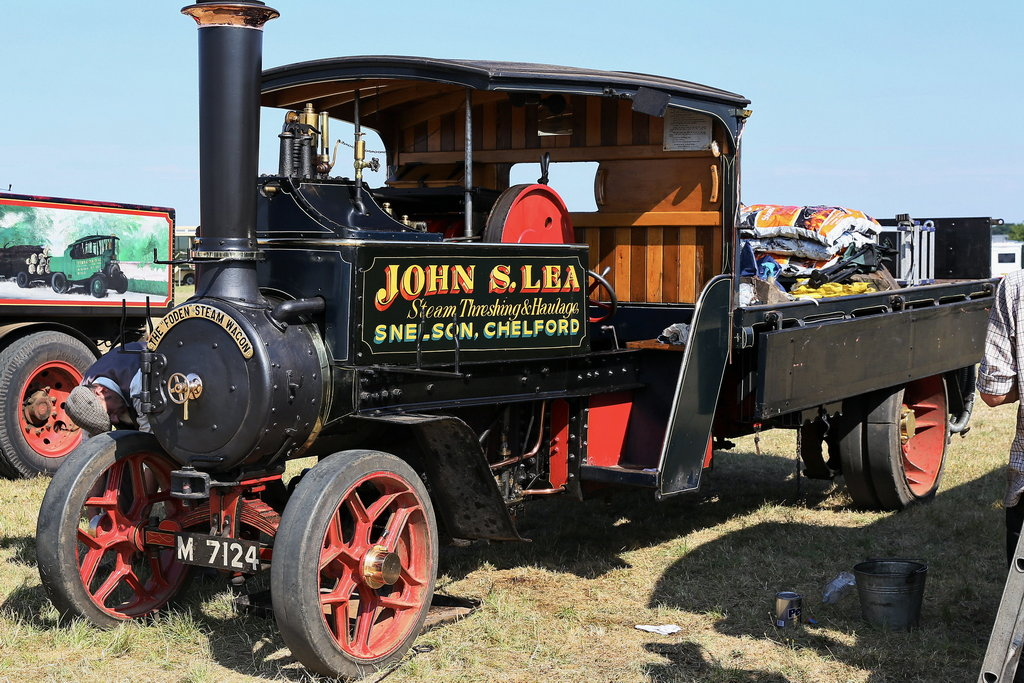
Foden Steam Wagon
As legislation allowed Foden produced traction engines from 1878, and lorries from 1896, and then military vehicles from 1901. Foden went diesel in the early 1930s, acquired by Paccar in 1980 and the brand was retired in 2006.
Years
1921
Engine
Steam
Body Style
Steam Wagon
Production
Power: Weight
Dimensions
Stanley Steamer
These later models had aluminium coachwork resembling those of contemporary petrol cars (which provided increasingly difficult competition), but they retained steam-car features by having no transmission, clutch, or driveshaft. They also had a fully sprung tubular steel frame.
Years
1921
Engine
Steam
Body Style
Saloon Car
Production
Power: Weight
Dimensions
Mann Steam Cart
Mann made some of the earliest steam carts from about 1898, and had successful ranges of 3 and 5 ton trucks. Eventually taken over by Atkinson, and sold to Scammell.
Years
1925
Engine
Steam
Body Style
Steam Cart
Production
Power: Weight
Dimensions
GWR 6000 King George V
4-6-0 locomotive; the largest class built by the GWR. Handled the principal GWR expresses on the main line from London to the West of England and on the Chiltern line to Birmingham and Wolverhampton, until 1962.
Years
1927
Engine
Steam
Body Style
Locomotive
Production
.
Power: Weight
.
Dimensions
.
Sentinel Steam Bus
Sentinel made steam road vehicles from 1905. From 1923, they were assembled in a radical new plant at Shrewsbury, which made 1550 vehicles on a flow line based on the Ford Model T factory in Michigan.
Years
1931
Engine
Steam
Body Style
Bus
Production
.
Power: Weight
.
Dimensions
.
Sentinel S6 Steam Truck
A new and advanced steamer, with a single-acting four-cylinder underfloor engine with longitudinal crankshaft and an overhead worm-drive axle. They became the biggest ever selling steam lorry. Undone by legislation on weight.
Years
1934
Engine
Steam
Body Style
Locomotive
Production
.
Power: Weight
.
Dimensions
.
LNER Class A4 4468 Mallard
A streamlined 4-6-2 (“Pacific”) built at Doncaster Works to a design of Nigel Gresley. Has held the world speed record for steam locomotives at 126 mph since 1938.
Served with Coventry Fire Service during the blitz, then Jaguar works.
Years
1939
Engine
.
Body Style
.
Production
.
Power: Weight
.
Dimensions
.
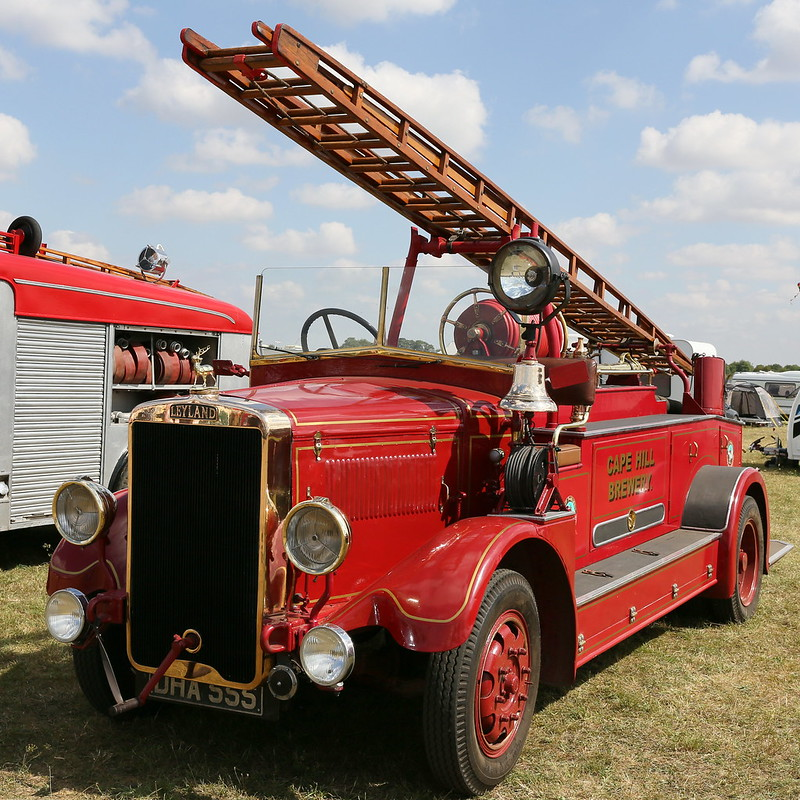
Leyland Fire Engine
.
Years
1940
Engine
.
Body Style
.
Production
.
Power: Weight
.
Dimensions
.
Karrier Fire Engine
.
Years
1952
Engine
.
Body Style
.
Production
.
Power: Weight
.
Dimensions
.
Dennis F8 Fire Engine
.
Years
1953
Engine
.
Body Style
.
Production
.
Power: Weight
.
Dimensions
.
Land Rover Fire Engine and Coventry Climax FW Godiva Fire Pump
The famous Coventry Climax engine adapted for racing car use by Lotus, Cooper and others.
Years
1953
Engine
.
Body Style
.
Production
.
Power: Weight
.
Dimensions
.
Bedford Green Goddess Fire Engine
.
Years
1956
Engine
.
Body Style
.
Production
.
Power: Weight
.
Dimensions
.
Alvis Salamander Pyrene Fire Crash Tender
Shares the six-wheel-drive chassis with the FV 601 Saladin armoured car. Firefighting equipment by The Pyrene Company Limited could produce 7,500 gallons of foam per minute and carried a crew of 6.














.jpg)